How to Store Firewood Outside and Keep It Dry
A good firewood store keeps rain off without trapping moisture inside. The useful question is not simply whether the logs are covered: it is whether the whole stack can dry, stay stable and be reached when you need it.
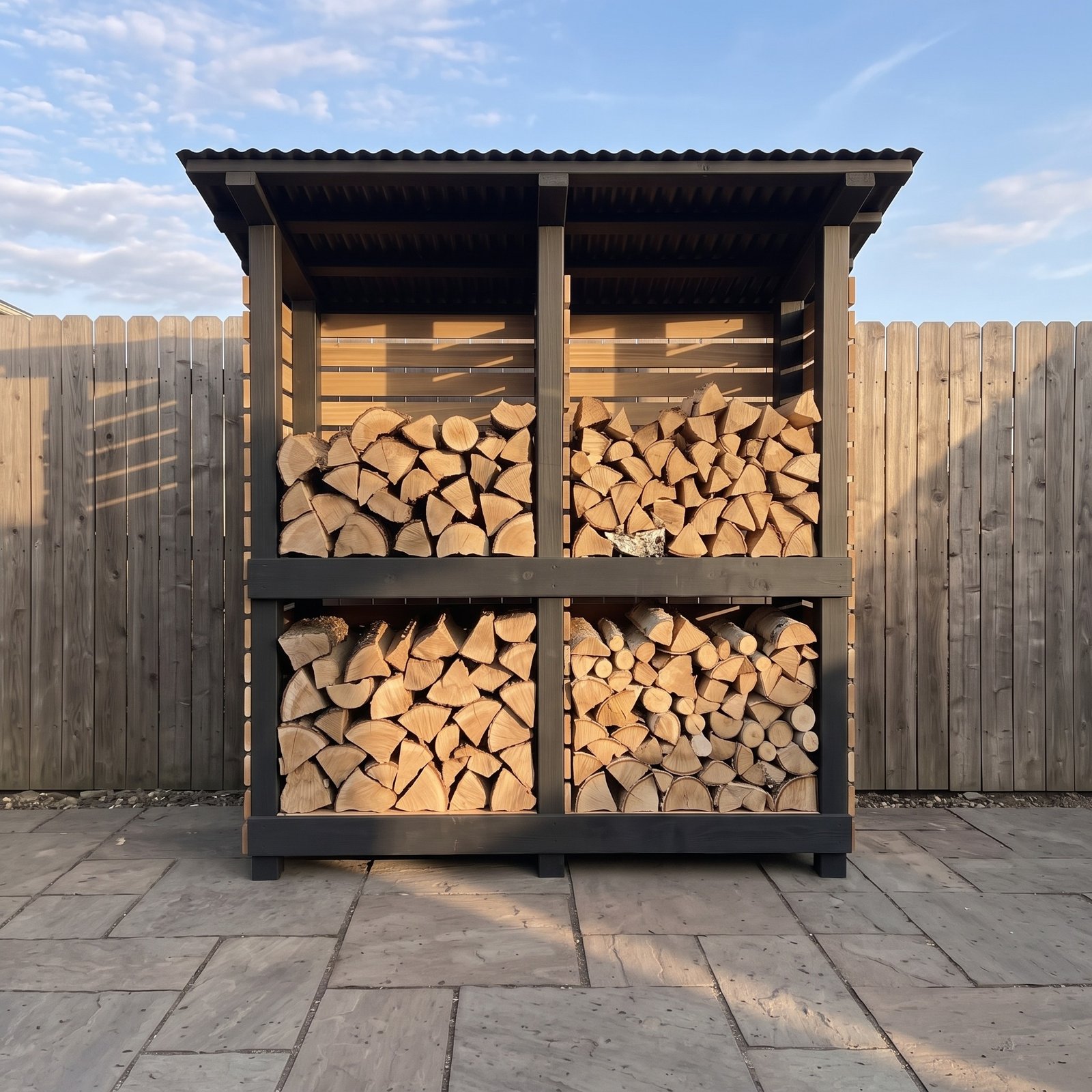
Stack split logs on a stable support above the ground, protect the top from rain and leave the sides open to moving air. Separate drying wood from ready-to-burn wood. Before burning, check moisture on a freshly split face; aim for less than 20%, following your appliance and meter instructions.
Choose the location before choosing the log store
Visit the proposed spot after rain. A convenient corner beside the back door may also be where a downpipe overflows or the garden drains. Look for firm support, an approach you can use in winter and room to inspect the back of the stack. A store that is difficult to reach tends to become a pile rather than an organised supply.
Think through the complete route: delivery point, splitting area, storage and the final trip indoors. If a wheelbarrow cannot turn at the store, mark a different location before building. Keep drainage routes and access covers clear. Avoid placing a stack where it obstructs a door, a vent or an escape route.
Sun can help, but an enclosed sunny corner is not automatically better than an airy site. Check what surrounds the stack: a solid fence, dense hedge and house wall can leave only the front exposed. Trim back vegetation and leave enough working space to remove leaves and inspect supports without dismantling the pile.
There is no single clearance from a house that is suitable everywhere. Wildfire requirements, local rules and the building layout matter. Do not assume that an attractive photograph of logs against timber siding is an appropriate arrangement for your property.
Keep the bottom row out of standing water
Use a purpose-built rack or a supported slatted floor suited to the full load. A few loose boards on mud can sink unevenly as the stack fills. Keep the air space beneath the logs clear of leaves, weeds and offcuts, and check that roof runoff cannot splash back into the bottom row.
Ground clearance should suit splash, snow and site drainage rather than an arbitrary universal number. You need to be able to see that the lowest logs stay clear of wet ground throughout the season. For a permanent timber store, compare the support options in our shed foundation guide.
Should you use a tarp, an open rack or a roofed store?
| Storage arrangement | Useful when | Main thing to get right |
|---|---|---|
| Raised stack with a top cover | You need a flexible, inexpensive seasonal arrangement | Secure the cover and give water a route off it |
| Open rack beneath an existing roof | A genuinely sheltered, airy space is already available | Check wind-driven rain and runoff from the main building |
| Freestanding roofed log store | You want a permanent place with organised compartments | Match the usable capacity and anchoring to the site |
| Closed tool shed | You are considering sharing existing storage | Do not assume it is suitable for seasoning a large wet delivery |
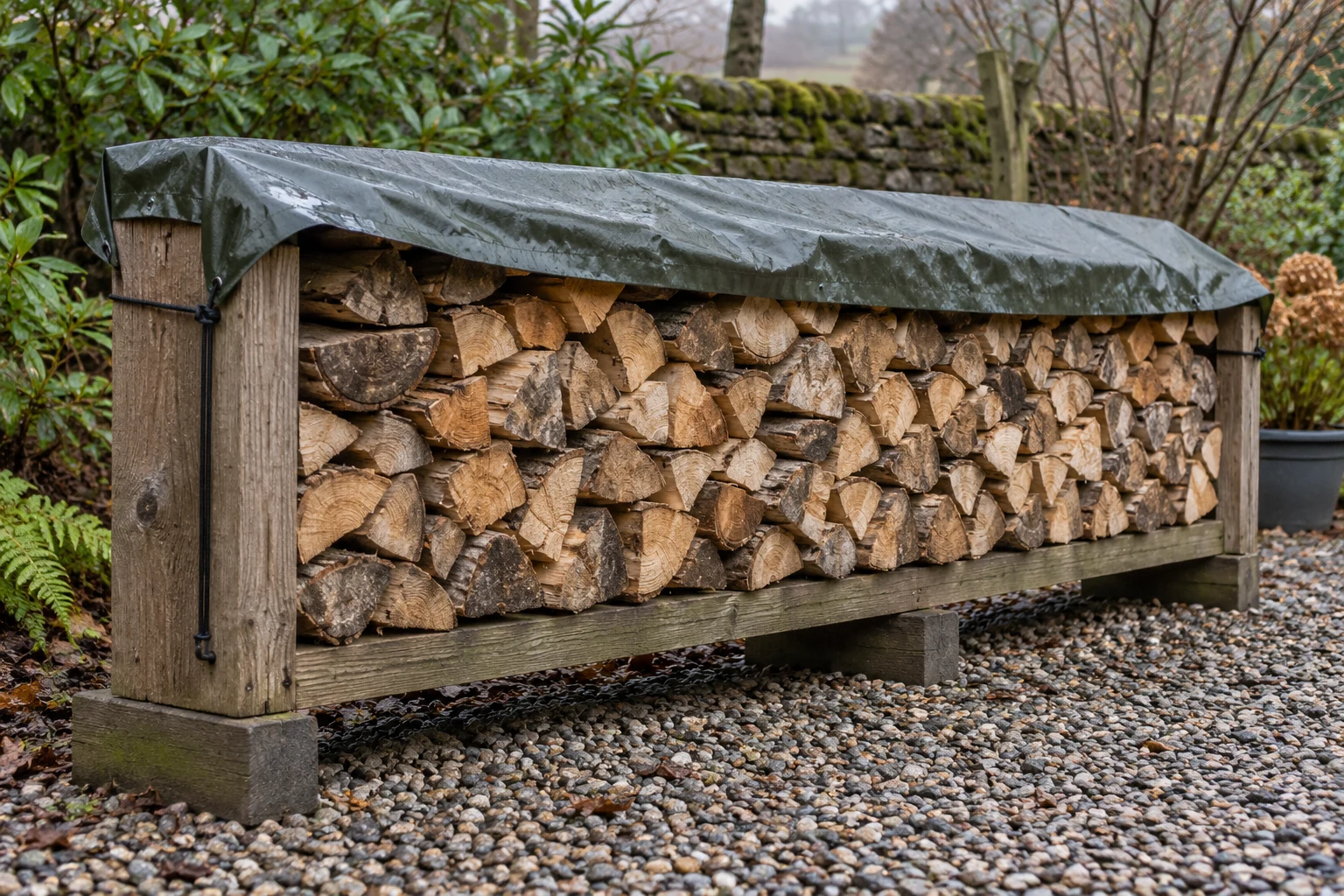
A tarp should shed water, not form a basin above the logs. Support it so that it slopes, fasten it securely and keep it from wrapping the sides of the stack. Check it after windy weather: a loose edge can turn a top cover into a wet curtain pressed against the wood.
The EPA’s archived Burn Wise guidance recommends outdoor storage above the ground with the top covered and sides open. That is a useful principle for both a temporary stack and a permanent log store.
A roof adds convenience, but roof area is not storage capacity. Measure the internal space occupied by logs, then check the overall roof footprint against your site. Overhangs, partitions and posts all affect the relationship between the two. Our firewood capacity calculator and sizing guide converts clear stack dimensions into cubic feet, cubic metres and full cords.
The tiered firewood storage shed plans use four open compartments and a sloping roof. Separate compartments make it easier to keep batches apart. Check the product dimensions and usable capacity against your delivery before choosing the design.
Plans for your next build
Firewood storage and other useful garden builds.
Stack for airflow, stability and the next delivery
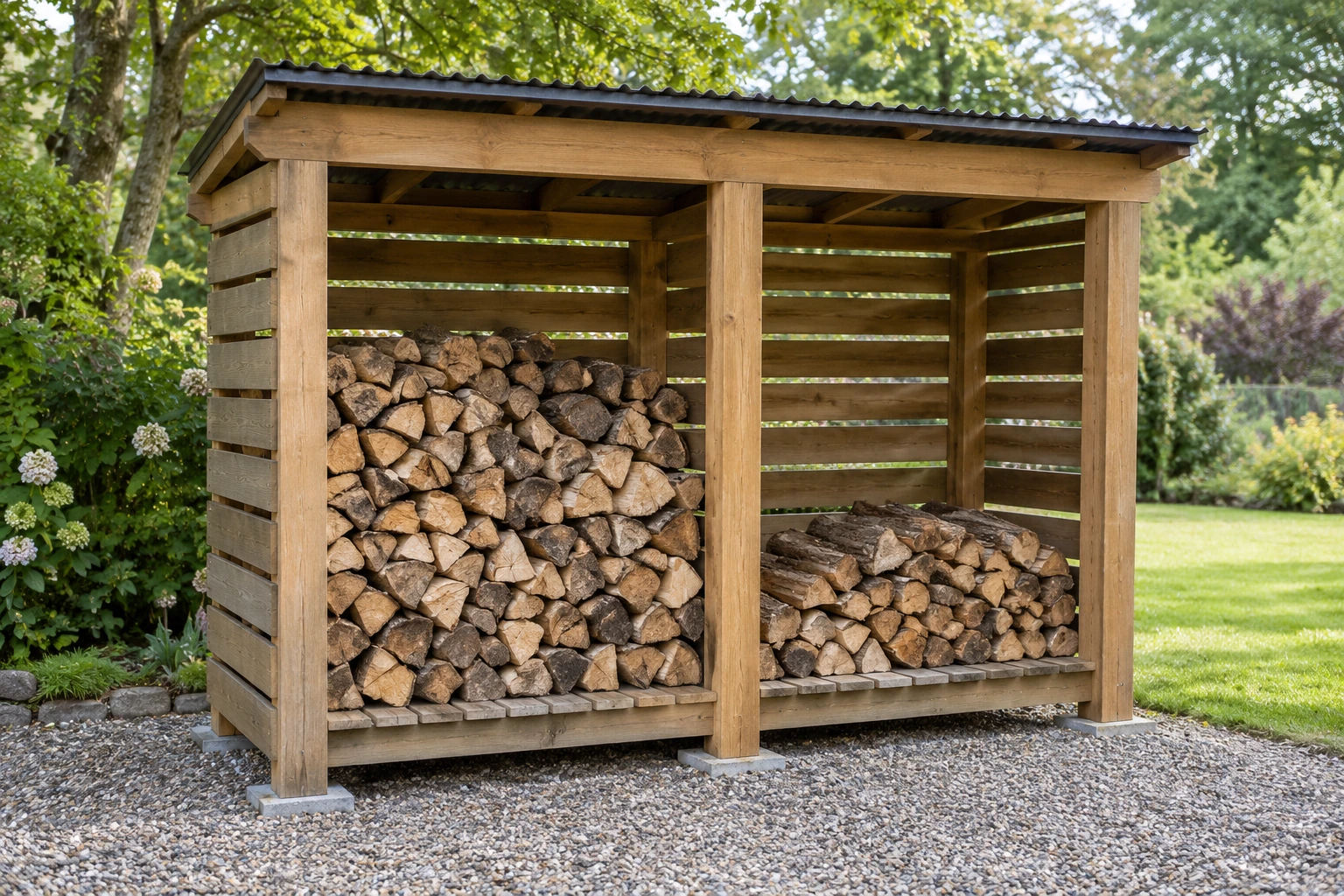
Start with a stable, level support and sound end restraints. Place logs deliberately so they do not rock or form a leaning face. Do not use the house wall or a lightweight fence as an improvised retaining structure. Keep the load within the rack or plan’s design limits.
For drying, favour accessible rows over a deep block whose centre you cannot inspect. A narrow rack can work well for one row of standard-length logs; a deeper store needs a deliberate loading and unloading arrangement. Do not pack every remaining cavity just because it appears to be spare capacity.
As a layout example, two rows of 16 in logs (40.6 cm) with a chosen 4 in (10.2 cm) clear space between them occupy 36 in (91.4 cm) front to back. The gap is not firewood capacity. This is a planning example, not a prescribed ventilation gap: your logs, rack and exposure determine the actual arrangement.
Give each batch a destination
- Incoming wood: record the delivery date and whether it was sold as green, seasoned or kiln-dried. Check it rather than relying on the label alone.
- Drying wood: keep it in a ventilated location and avoid burying it behind a newer batch.
- Ready wood: identify the batch that has passed your moisture checks and draw from that batch first.
- Small indoor supply: bring in only what you need and follow the stove or fireplace clearances.
If you have two bays, aim to empty one before refilling it. If you have one bay, avoid placing a fresh load in front of your dry supply. The right system is the one that lets you take the oldest suitable logs without pulling supporting pieces out of the bottom of a tall pile.
How do you know when firewood is dry?
Cracked ends, loose bark and a lighter feel are clues, not reliable pass-or-fail tests. Rain can wet the exterior of a dry log, while an apparently dry exterior can hide a wetter centre. A meter reading on the exposed end alone can therefore mislead you.
EPA’s moisture-meter instructions explain testing the newly exposed face after splitting. Take readings from more than one location and more than one log. Follow the meter’s pin direction, species settings and temperature corrections; a cold log can affect the indicated result.
Pick samples from different parts of the delivery, including some of the larger pieces. Keep a simple record of the date, batch and readings. If several readings remain high, continue drying that batch and check again later. A favourable reading from the smallest log at the sunny front is not evidence that the centre of the pile is ready.
Seasoning time varies with species, split size, starting moisture, weather and storage. Avoid promising yourself that every delivery will be ready after a fixed number of months. Plan enough storage to allow a drying batch and a usable batch to coexist; the sizing guide explains why peak inventory can exceed a single delivery.
Troubleshooting wet firewood storage
| What you find | Check first | Useful next action |
|---|---|---|
| Wet bottom row | Ground contact, splash, blocked drainage or sagging supports | Correct the support and water route before reloading |
| Dry outside, wet middle | Row depth and blocked side ventilation | Reorganise into accessible rows and retest split faces |
| Wet front after storms | Prevailing rain direction and roof coverage | Reassess orientation or protection without sealing the whole stack |
| Water beneath the roof in dry weather | Condensation on cold roofing | Read our condensation troubleshooting guide |
| Leaning stack or spreading rack | Uneven loading, movement at supports and overloaded bays | Unload safely and correct the structural problem |
| Dry logs trapped behind a delivery | Loading order | Assign separate bays or a clear batch rotation route |
Before the next delivery
Clear the ground around the store, check its anchoring and remove damaged supports from service. Inspect roofing and gutters from a safe position. Measure the space that is actually empty, then confirm the supplier’s delivery quantity and log length. A “load” is not a consistent volume between suppliers.
For a new wooden store, choose timber and exterior fasteners for the exposure. See cedar versus pressure-treated wood and our outdoor screw guide. These choices support durability; they do not replace suitable load-bearing details and anchoring.
Common questions
Should firewood be completely covered?
Protect the top from precipitation while allowing air to move around the stack. Wrapping a damp stack tightly in plastic works against drying. A temporary storm cover still needs to be arranged so moisture can escape afterwards.
Can kiln-dried firewood be stored outside?
Yes, provided it is protected from rain and ground moisture and stays ventilated. Kiln drying describes its processing, not a permanent resistance to rewetting. Check moisture before use if storage conditions have been poor.
Can I season firewood in my tool shed?
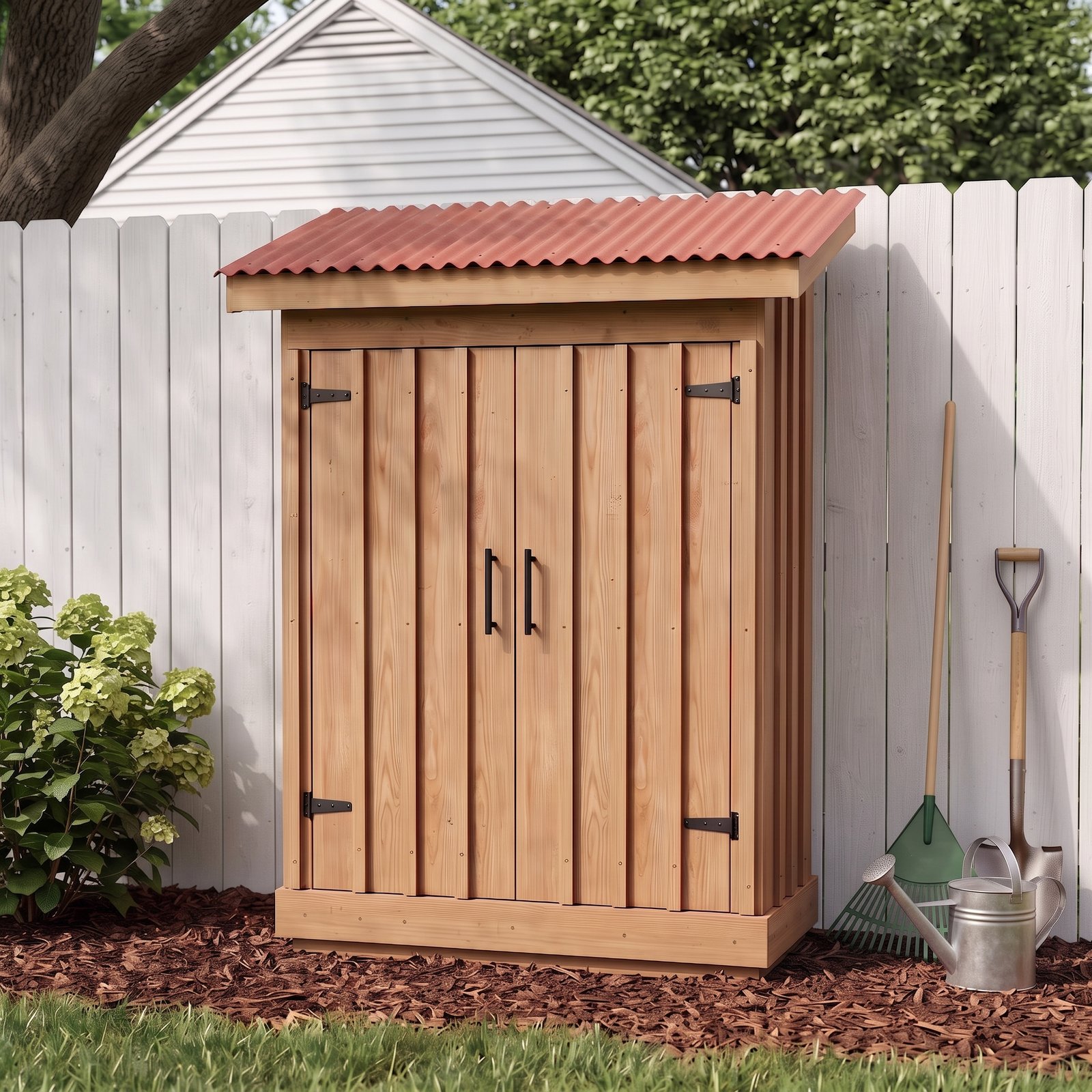
A closed shed can trap the moisture released by a wet load and expose tools and other contents to damp. Prefer a ventilated log store; assess the shed’s airflow and moisture conditions before using it for firewood.
Does a roofed log store mean the wood is ready to burn?
No. A roof helps manage weather exposure. Readiness depends on the wood’s internal moisture, which needs checking separately.