What Size Firewood Rack or Shed Do You Need?
Choose a log store by the amount of stacked wood you need to hold, then check that the usable space can actually accommodate it. Roof width, outside dimensions and a product name such as “large” are poor substitutes for measuring the storage bays.
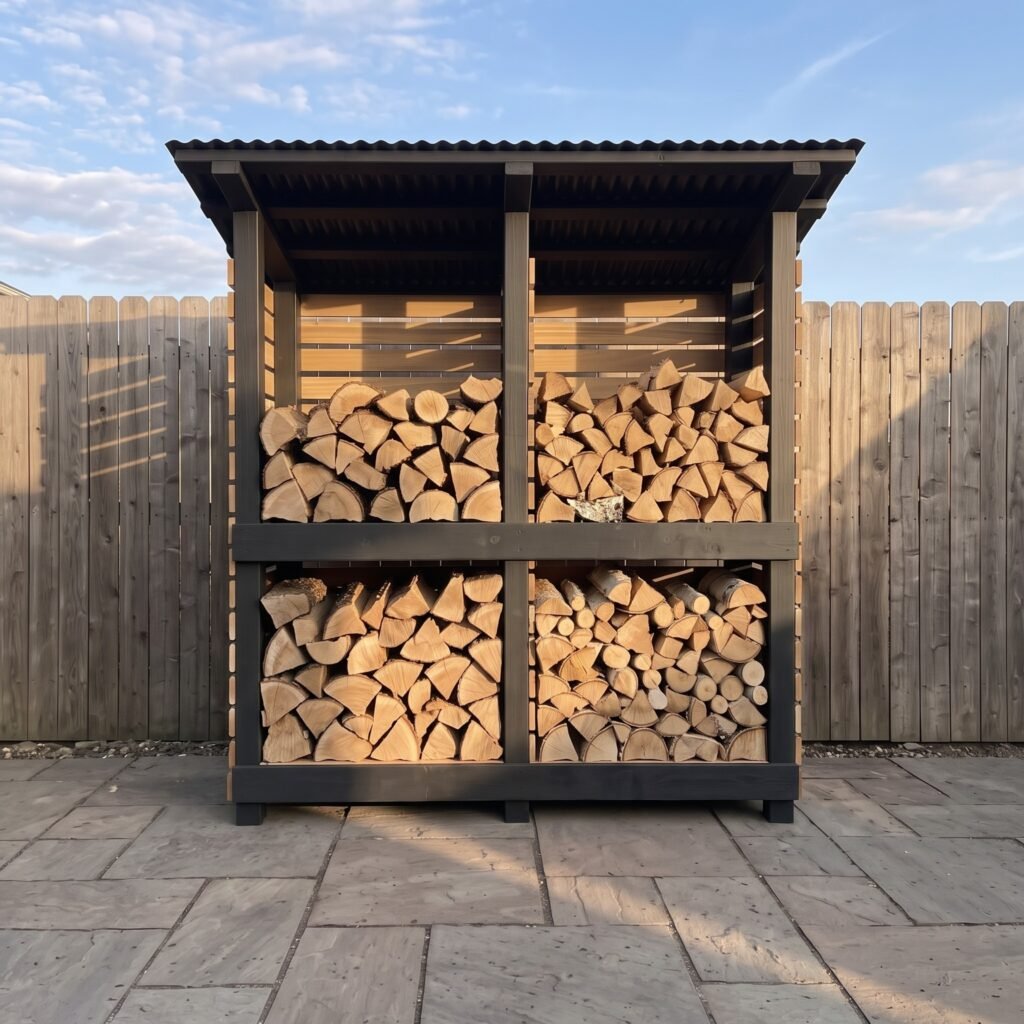
Estimate the largest quantity you will store at one time, including both dry wood and wood still seasoning. A full cord occupies 128 ft³ (about 3.62 m³) of stacked space. Calculate each usable bay as length × stacking height × occupied log depth, then add the bays. Exclude posts, access gaps and unused roof space. Check load capacity separately.
A cord measures a stack, not solid wood
NIST defines a cord of firewood as exactly 128 cubic feet. A familiar arrangement is a stack 96 in long × 48 in high × 48 in deep (243.84 × 121.92 × 121.92 cm): 8 × 4 × 4 ft = 128 ft³. Other shapes can hold the same volume. See NIST’s measurement tables.
The measurement includes the ordinary spaces between reasonably stacked logs. Do not calculate the outside volume of a stack and then subtract a generic percentage for the air between individual pieces when expressing it in cords. However, a deliberate empty aisle or a large ventilation gap between rows is not stacked firewood and should not be counted.
What is a face cord?
Treat “face cord” or “rick” as a prompt to ask for dimensions. A stack 96 in long × 48 in high (243.84 × 121.92 cm) with 16 in (40.64 cm) logs contains about 42.67 ft³ (1.21 m³), which is one-third of a full cord. If the logs are 24 in (60.96 cm) long, the same face area contains half a cord. The depth changes the quantity.
For a delivery, confirm the actual measurement basis with the seller: stacked volume, loose volume or another stated unit. A loose tipped pile cannot be converted accurately using only the rectangular space around its irregular outline. Plan around the quantity that will occupy your store after stacking.
Firewood storage capacity calculator
Enter the dimensions of one rectangular stack. Use the occupied log depth, not the entire shed depth if part of it remains empty. For separate rows with a deliberate gap, calculate each row separately and add the results.
This estimates geometric stacked volume. It does not rate the floor strength, predict drying time or guarantee that an advertised delivery will fit. The static examples below show the same calculation if you prefer to work it out yourself.
How much does an 8-foot firewood rack hold?
Length alone is not enough. An 8 ft rack with one shallow row holds much less than an equally long store with several rows. The following examples all use clear stacking dimensions, not outside frame dimensions.
| Stack length × height × depth | Stacked volume | Full cords |
|---|---|---|
| 48 × 48 × 16 in (121.92 × 121.92 × 40.64 cm) | 21.33 ft³ / 0.60 m³ | ⅙ |
| 96 × 48 × 16 in (243.84 × 121.92 × 40.64 cm) | 42.67 ft³ / 1.21 m³ | ⅓ |
| 96 × 48 × 24 in (243.84 × 121.92 × 60.96 cm) | 64 ft³ / 1.81 m³ | ½ |
| 96 × 48 × 48 in (243.84 × 121.92 × 121.92 cm) | 128 ft³ / 3.62 m³ | 1 |
The final row could represent three rows of 16 in (40.64 cm) logs with no extra gaps between rows. If the design includes ventilation spaces, add those spaces to the physical depth required while keeping the stacked wood quantity unchanged. These are volume examples, not recommended stack heights or structural designs.
Work backwards from the quantity you want to store
Required clear length equals target stacked volume divided by stacking height and occupied depth. Use consistent units. For half a cord at a 48 in (121.92 cm) stacking height and one 16 in (40.64 cm) row, the clear length is 12 ft, or 144 in (365.76 cm).
That is longer than many people expect from the phrase “half a cord.” You could divide the quantity across two bays, increase the occupied depth through more rows, or choose another arrangement. Any change in height or depth must still suit the rack’s design and how you will safely load and empty it.
Before moving a batch into use, check firewood moisture on a freshly split log
Firewood storage plans
Compare the tiered four-bay layout with the asymmetric log-and-kindling layout · Check usable bay dimensions against your stacked firewood volume
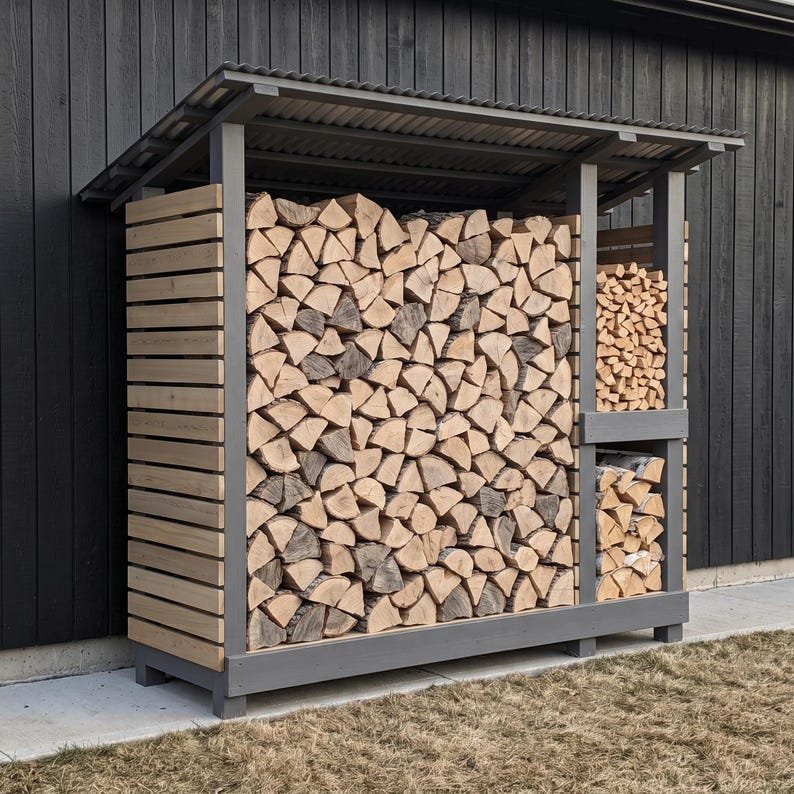
Size for your peak inventory, not just annual use
Estimate seasonal usage with our firewood consumption calculator, then compare your stock target with the storage capacity above
Your storage requirement depends on when deliveries arrive and how much older wood remains. A household using one cord a year might need less than a cord of storage with frequent dry-wood deliveries, or substantially more if next season’s wood arrives before this season’s supply has been used.
Wood already stored + incoming delivery − wood used before delivery = space needed when the delivery arrives.
Example: 0.4 cord remaining + a 1 cord delivery − 0.1 cord used before it arrives = 1.3 cords. That is 166.4 ft³ (about 4.71 m³) of stacked wood, before allowing for separate access and ventilation spaces.
Use your own delivery records if available. Count bags or baskets over a representative period only when you know their consistent volume and packing; casual basket counts are a rough usage indicator, not a precise cord measurement.
For a first season, ask your supplier about delivery sizes and lead times, then choose a modular layout if demand is uncertain. Avoid a universal “cords per house” estimate. Climate, insulation, appliance efficiency, the area heated and how often you burn all change consumption.
Separate ready-to-burn and seasoning wood
Plan where each batch goes. Two independently accessible bays make rotation easier than a deep store that forces you to bury older logs behind a new delivery. Label the batches by delivery date or condition and use an arrangement that lets you reach the older wood first.
EPA’s archived Burn Wise guidance recommends keeping wood off the ground with the top covered and the sides open to drying air. It also recommends checking moisture rather than burning wet wood. The programme is no longer updated, but its storage guidance remains available. Read the guidance.
Measure the usable storage bay
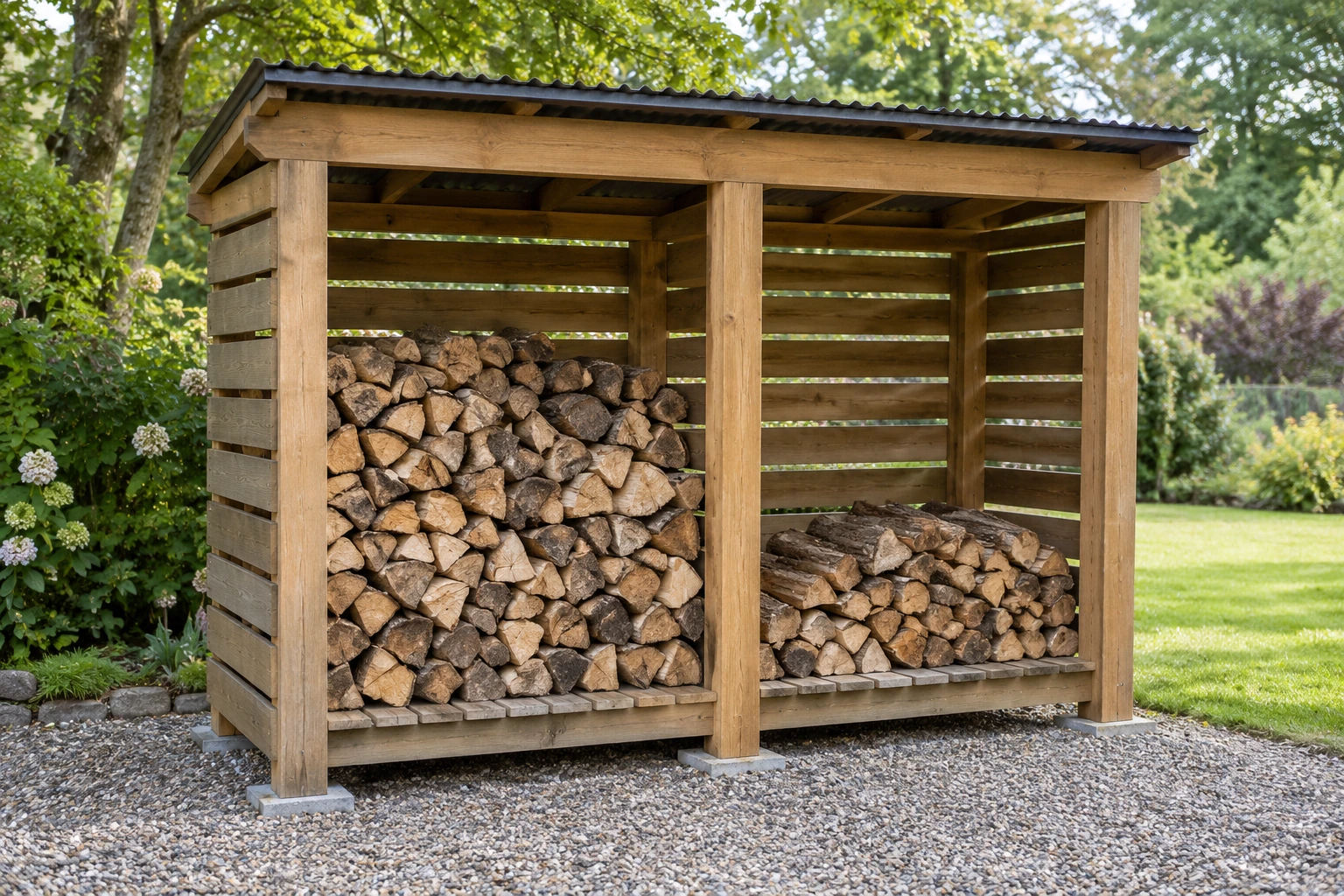
Make a sketch of the empty store and record these three dimensions for each bay:
- Clear length: between posts, dividers or other obstructions, not across their outside faces.
- Usable height: from the supporting floor to your intended stack top, allowing for the roof and the design’s limits.
- Occupied depth: the actual depth of the log rows, excluding deliberate gaps and unused space.
Take measurements at the narrowest relevant locations. A diagonal brace can reduce the usable corners of a bay. Do not count an awkward triangular pocket as useful storage merely because it appears inside the roof outline.
A worked example with frame deductions
Suppose a simple store is 96 in (243.84 cm) wide outside two end posts, each 3½ in (8.89 cm) thick, with no central divider. The clear length is 89 in (226.06 cm). At a chosen stack height of 42 in (106.68 cm) and one row 16 in (40.64 cm) deep, the volume is:
89 × 42 × 16 ÷ 1,728 = 34.61 ft³
34.61 ÷ 128 ≈ 0.27 cord
Metric equivalent: approximately 0.98 m³
Using the outside width and assuming a 48 in (121.92 cm) stack height would suggest one-third of a cord instead. Neither the posts nor the unused height stores logs, so that larger figure overstates the chosen arrangement.
What about a sloping roof or tiered store?
For early planning, use a rectangular envelope that fits below the lowest obstruction and within the permitted stacking height. This gives a conservative, easy-to-use estimate. If the design explicitly permits a shaped stack, break it into measured sections instead of treating the entire roof volume as available.
For tiered storage, calculate each usable compartment separately. Subtract shelves and dividers, and check how logs can be inserted and removed. A shelf opening may technically contain a volume that is inconvenient to use because the last row is difficult to reach.
Leave room for air, rain protection and access
A larger enclosed box is not automatically better firewood storage. Give drying air a route through the stack and keep roof runoff away from the lower wood. A cover should protect the top without turning the whole pile into a tightly wrapped parcel.
Choose the location with the delivery and daily collection route in mind. You need room to stand, turn and handle logs even when the bays are full. Check applicable local fire-safety guidance for positioning relative to buildings, particularly in wildfire-prone areas; do not copy a universal distance from a generic garden photo.
Before committing to a deep design, simulate reaching the back row. Will you empty the front first every time? Can separate bays be filled from different sides? A little less theoretical capacity can be more useful if you can manage and rotate the wood without unloading everything.
Use actual log lengths
Measure several logs from your normal supplier. Mixed lengths can prevent tidy rows or protrude beyond the roof’s protection. The store must accommodate the wood you buy, while the logs must also suit your appliance. Do not select a longer standard log solely to improve the rack’s calculated capacity.
Volume capacity is not weight capacity
A bay may have enough geometric space for a cord without having a floor designed to carry it. Firewood weight varies with species and moisture. Do not convert cords into a single universal load and assume the structure is adequate.
Check the permitted load, floor spans, connections and foundation against the plan. Avoid extending a store by lengthening floor members without reviewing the design. A supported additional bay is a different modification from making an existing span longer.
Our shed foundation guide explains the difference between continuous and discrete supports. The outdoor timber comparison and screw guide help with material selection once the structure is specified.
Choose the store after checking these numbers
- Largest expected quantity on hand at once
- Normal log length and number of rows
- Clear storage volume after frame and access deductions
- Separate space for seasoning and ready-to-use batches
- Permitted stacking height and structural loading
- Overall footprint including roof, working space and the base
For a compartmented design, explore the Firesided tiered firewood storage shed plans. Compare its plan dimensions and compartment layout with your calculated need; the generic examples in this article are not a capacity rating for that product. If your site calls for a different arrangement, the custom plans service can start from your available footprint and storage brief.
Common questions
Is a face cord always one-third of a cord?
No. That fraction follows from a particular arrangement: 96 × 48 × 16 in (243.84 × 121.92 × 40.64 cm). Ask for all three dimensions rather than relying on the name.
Can I count the space between logs?
Ordinary inter-piece spaces are included in stacked volume. Separate empty aisles, large row gaps, roof voids and frame members are not part of the wood stack.
Should I buy a bigger store than my calculation?
Allow for your actual delivery pattern and any planned increase in use. Add that quantity explicitly rather than applying an unexplained percentage. Then provide the physical gaps and access space the design needs.