Your estimate
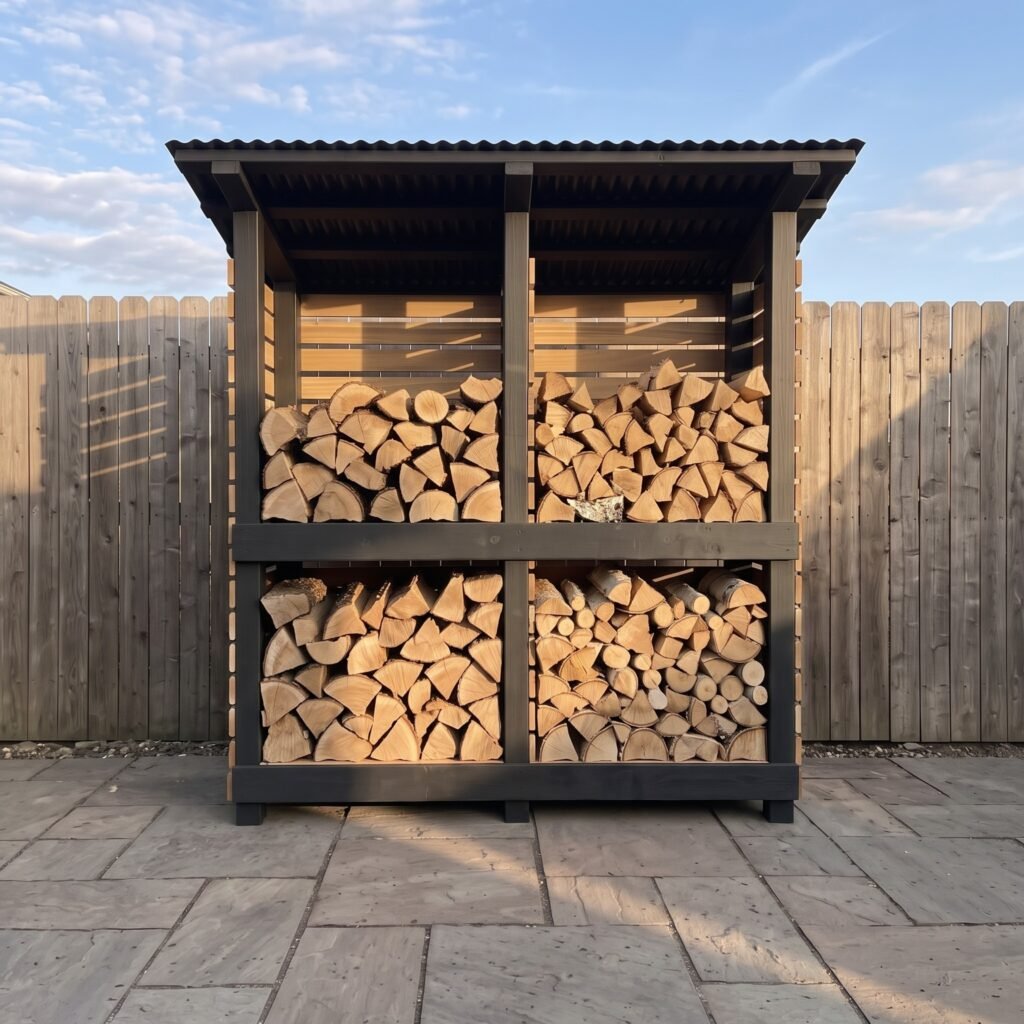
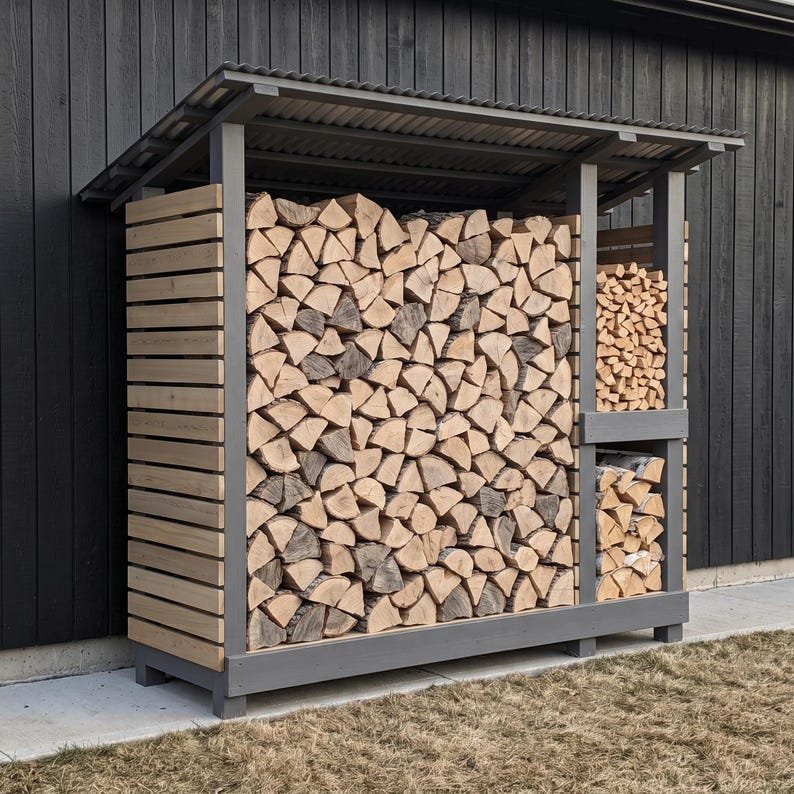
Firewood storage plans
Compare the tiered four-bay layout with the asymmetric log-and-kindling layout · Check usable bay dimensions against your stacked firewood volume
How much firewood should you buy for winter?
This firewood calculator offers two ways to estimate a season of wood burning · Choose Plan a new season if you have no usage history, or Use my measured consumption if you have recorded how much stacked wood you burn
Plan a new season without previous consumption
Enter the heat output you expect from your closed log stove, your hours of active burning per day and the number of days you expect to light it · Metric uses kW for output and m³ for stacked wood · Imperial uses BTU/h and ft³ · Both show the equivalent in full cords
Set your extra-stock percentage, check the stove-efficiency assumption and enter any usable wood already stored · The total seasonal stock target includes the extra allowance · Approximate firewood to buy subtracts your existing stock from that target, with a minimum of zero
This method assumes the entered heat output throughout every burning hour · A stove running below its rated output will use less wood than a calculation using that rating for the same hours · The tool does not calculate your home’s heat loss or choose a stove size
Planning formula and assumptions
Heat supplied in kWh = output in kW × hours per day × burning days
Fuel energy = heat supplied ÷ (efficiency ÷ 100)
Stock target = fuel energy ÷ energy per stacked m³ × (1 + extra stock ÷ 100)
Wood to buy = stock target − existing stacked wood, with a minimum of zero
The range uses 1,400–2,000 kWh of fuel energy per stacked m³ of logs at about 20% moisture · The editable 70% efficiency is a starting assumption for a traditional closed log stove · Use the efficiency documented for your stove where available
These assumptions come from Forest Research’s wood energy figures and guide to domestic heating with logs · The range reflects wood energy density, not every possible winter · Weather, firing rate, moisture and efficiency can put actual use outside it · These assumptions do not apply to an open fireplace
First-season buying example
A 5 kW stove used for 4 hours on each of 120 days supplies 2,400 kWh of heat · At 70% efficiency, with 15% extra stock and no existing wood, the estimate is about 2.0–2.8 stacked m³, or 0.5–0.8 full cords · With 0.5 m³ already stored, the buying range falls to about 1.5–2.3 m³
Estimate from measured consumption
Enter the stacked volume you actually used, how many burning days it lasted, the similar burning days expected for your season and an extra-stock percentage · This mode returns a total stock target and does not subtract wood already stored · Subtract usable stock yourself when deciding what to buy
Daily usage = measured stacked volume ÷ burning days measured
Seasonal consumption = daily usage × expected burning days
Stock target = seasonal consumption × (1 + extra stock ÷ 100)
For example, 8 ft³ used over 10 burning days gives 0.8 ft³ per day · Over 120 similar days that is 96 ft³ · Adding 15% gives 110.4 ft³, or 0.863 full cord, about 3.13 m³
What stacked volume means
Measure the length × height × depth of a reasonably even stack, including normal gaps between logs · One full cord is 128 stacked ft³, about 3.625 m³ · A loose delivery load, bag or crate may use a different volume basis, so confirm the supplier’s measurement before ordering
A little help
Measure stacked volume consistently
Measure the length, height and occupied log depth of a reasonably stacked supply before and after use · Include the normal spaces between stacked logs, but exclude empty aisles · A loose bag or basket cannot be treated as a measured stacked volume
One full cord is 128 ft³, approximately 3.625 m³ · Use the firewood storage capacity calculator to measure a stack or size your storage bays
How much firewood will I need for winter?
If you have no usage history, choose Plan a new season and enter your stove output, burning hours and expected burning days · If you have measured consumption, choose that method and project a representative period over similar days · Both are estimates, so review your allowance as weather and burning habits change
Consumption and storage space are different
The stock target is seasonal consumption plus your chosen reserve · Your peak storage requirement also depends on delivery timing and any wood still seasoning · Do not add a universal air-gap percentage to the cord conversion