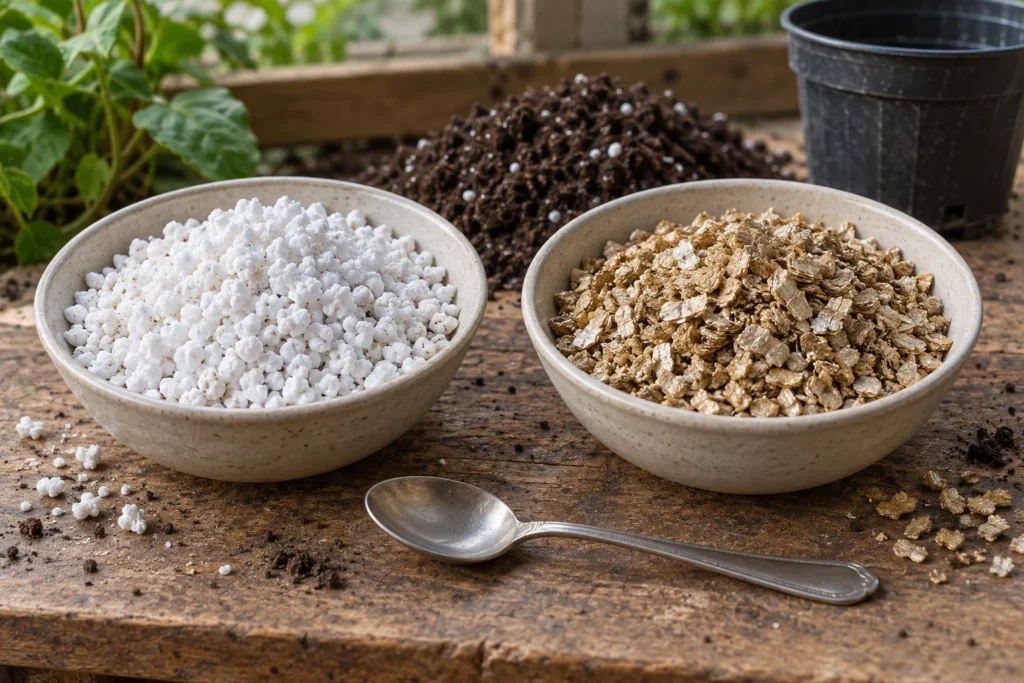
Perlite is commonly chosen to improve the air space and drainage of a potting mix, while vermiculite is commonly chosen to increase moisture retention
They are not exact opposites: both alter the mix, and the result depends on particle grade, proportion, the other ingredients and how the container is watered
What the two materials do
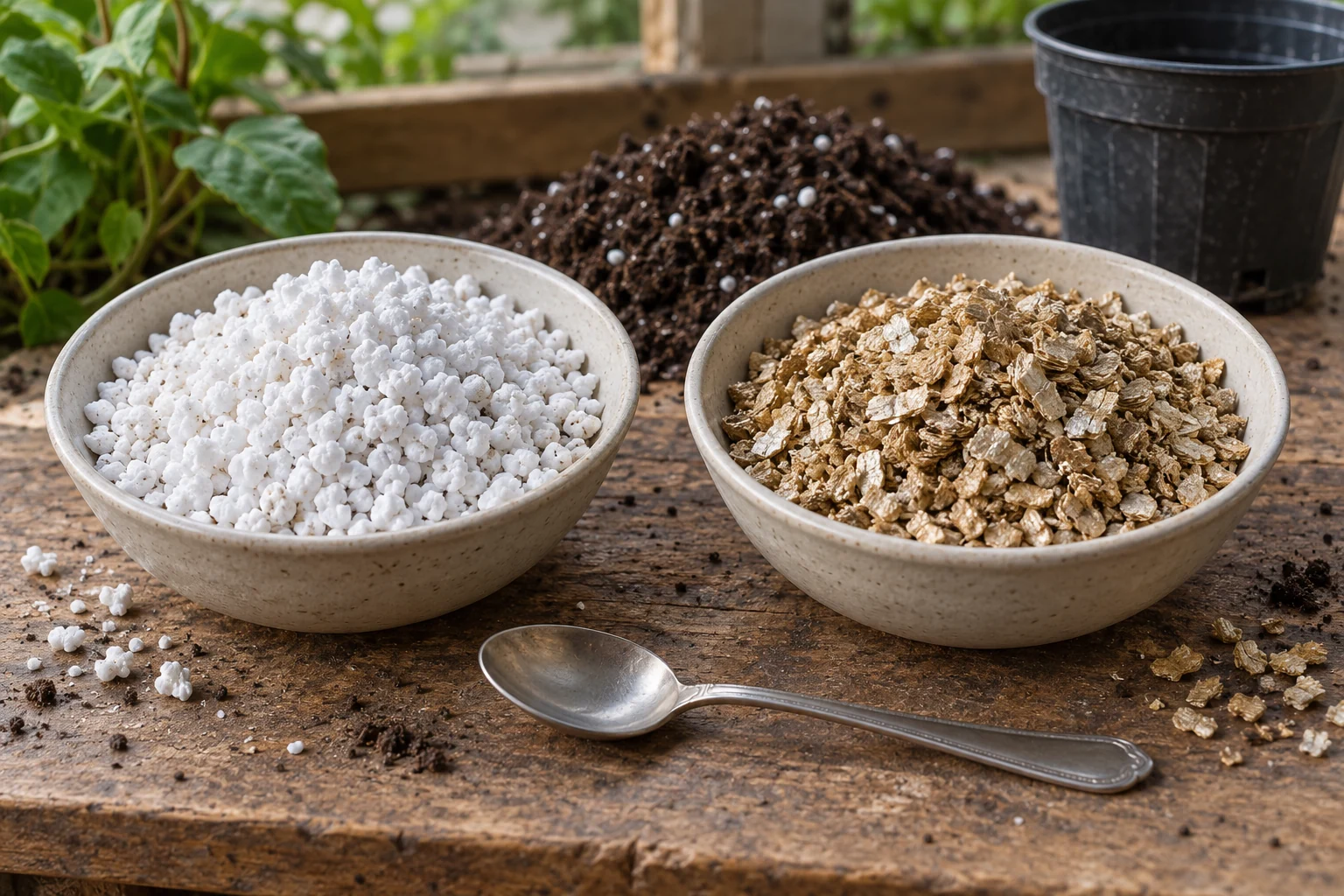
Perlite is an expanded volcanic material sold as lightweight pale granules; vermiculite is a heat-expanded mineral with a layered, flaky structure
University of Connecticut describes perlite as an amendment for drainage and aeration, and vermiculite as an amendment for moisture and nutrient retention; those roles are useful starting points, not a promise that one handful will correct any poorly performing pot
| Question | Perlite | Vermiculite |
|---|---|---|
| What does it look like? | Lightweight white or pale irregular granules | Lightweight layered flakes, often tan or golden brown |
| Why add it? | To adjust structure, air space and drainage | To adjust water and nutrient retention |
| Where might it help? | A suitable base mix that needs a more open structure | A suitable mix where steadier moisture is useful |
| What changes the result? | Grade, amount and the surrounding mix | Grade, amount and the surrounding mix |
| What does it not replace? | Drainage holes, suitable watering and an appropriate container | Drainage holes, suitable watering and an appropriate container |
Use horticultural products with a stated grade and purpose; building insulation or an unlabelled mineral material should not be treated as an equivalent potting ingredient
Identify the problem before changing the mix
If a pot stays wet, first check for blocked holes, water retained in an outer pot, a container much larger than the root system, and watering that is too frequent for current conditions
If a pot dries unusually fast, check whether it is root-bound, exposed to strong sun or wind, or filled with compost that has become difficult to wet; those situations call for different corrections
A dry surface does not always mean the whole root zone is dry, particularly with mixes containing coarse wood or bark; assess moisture below the surface and learn how heavy the container feels after watering and draining
Our guides to planter drainage and rehydrating dry potting compost help separate an outlet problem from a growing medium that is resisting water
Match the amendment to the plant and base mix
For a plant that dislikes persistent wetness, compare a purpose-made free-draining mix with a suitable base amended using an appropriate grade of perlite; do not assume that adding a little perlite turns dense garden soil into a dependable container medium
For seed sowing or plants that need a more even moisture supply, vermiculite may be useful as part of an appropriate mix; the seed’s requirements and the product directions still determine whether it belongs in the mix, on the surface, or neither
Fine and coarse grades behave differently, so a recipe specifying coarse perlite cannot be reproduced simply by measuring the same volume of fine dusty material
Commercial potting compost may already contain one or both ingredients; read the bag before adding more, and remember that a balanced ready-made mix does not need modifying merely because separate amendments are available
The RHS gives up to 25% by volume of coarse grit or perlite as an example for certain loam-based herb composts; that is a context-specific recommendation, not a universal proportion for houseplants, seedlings and succulents
Calculate proportions by the finished volume
If a suitable recipe calls for three parts base mix to one part amendment, the amendment is 1 ÷ 4 = 25% of the finished mixture by measured volume
A small example is 6 litres of base mix + 2 litres of amendment = 8 litres of measured ingredients; using the same container for every scoop keeps the ratio consistent
For a separate batch measured in US quarts, 6 quarts of base and 2 quarts of amendment follow the same 3:1 ratio; there is no need to convert between units if every part uses the same measure
Adding 2 litres to an existing 8 litres is different: the amendment is 2 ÷ 10 = 20% of the measured total, not 25%
These examples explain ratio arithmetic rather than recommend a blend; the final loose volume can also change as materials settle together, so use them as mixing proportions rather than an exact guarantee of how many pots will be filled
Mix evenly and handle dust carefully
Follow the bag’s handling instructions, work where airborne dust can be controlled, and use any protective measures the supplier specifies; avoid pouring dry material from a height into a cloud
Where the instructions permit, lightly dampen dusty ingredients before combining them; aim for an evenly moistened mix rather than a saturated one, and break up dry pockets before potting
Measure without crushing or packing the ingredients, combine them thoroughly and label any trial blend; concentrate on a small batch first so that a poor choice does not affect every plant
Mix the amendment through the rooting medium when that is what the recipe calls for; placing a separate layer at the bottom does not reproduce the same mixture or repair a pot with no outlet
Allow the filled container to drain after watering, then assess how it behaves under the plant’s actual growing conditions; a blend that works in a warm greenhouse may stay wet much longer on a cool windowsill
What neither amendment can do
Neither material turns exhausted compost into a complete fertiliser programme, removes accumulated salts or cures a diseased root system; follow the needs of the plant and the feeding guidance for the base compost
If reusing old material, assess its structure and history before deciding to refresh it; the old potting compost guide covers situations where reuse is reasonable and where replacement is a better choice
For a heavy planter, consider the weight and suitability of the entire mix rather than treating every mineral additive as interchangeable; the RHS also notes the environmental impact of manufactured perlite and discusses locally sourced grit where it suits the job
Choose the smallest useful change that addresses the actual problem, then observe watering and growth; adding both materials by habit makes it harder to understand which change helped
Sources and product instructions
Give the mix a well-designed home
A planter needs suitable growing space and clear drainage as well as the right compost blend