Garden Gate Hinges: How to Choose the Right Type and Size
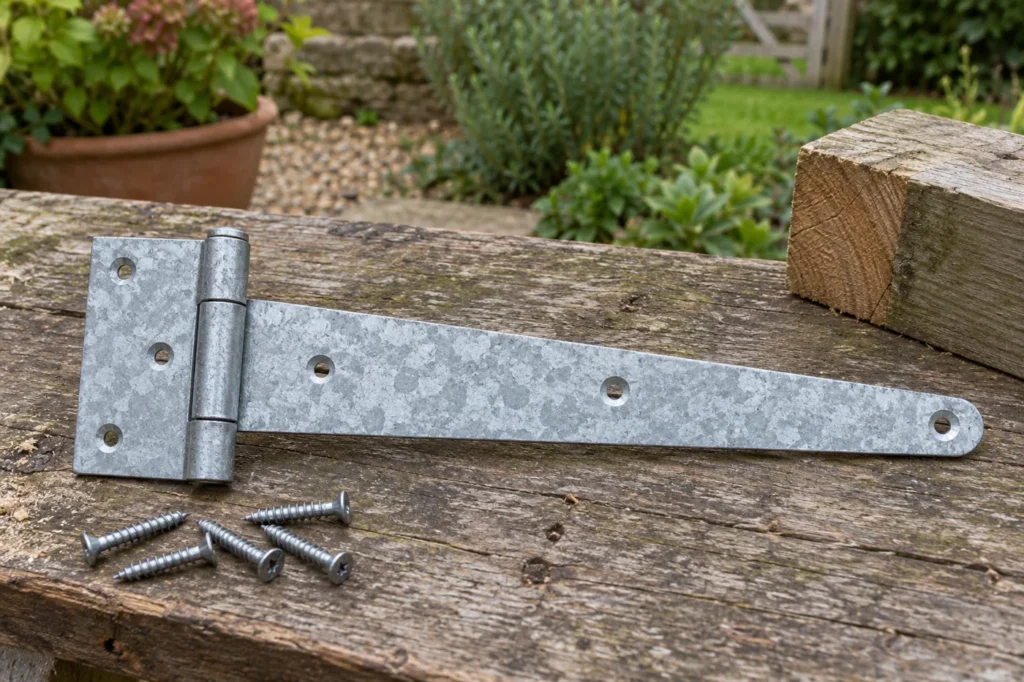
A hinge can look substantial and still be wrong for a gate. The useful questions are how much the finished gate weighs, how far it projects from the post, where the hinge can fasten into the frame and whether the gate needs to close itself.
Choose exterior gate hinges approved for the finished leaf’s weight, width and mounting arrangement. T hinges can suit lighter framed gates; adjustable hook-and-band sets are useful when alignment needs to be corrected later. Purpose-made self-closing hinges suit gates that must return closed. The post, frame and specified fixings must support the same installation.
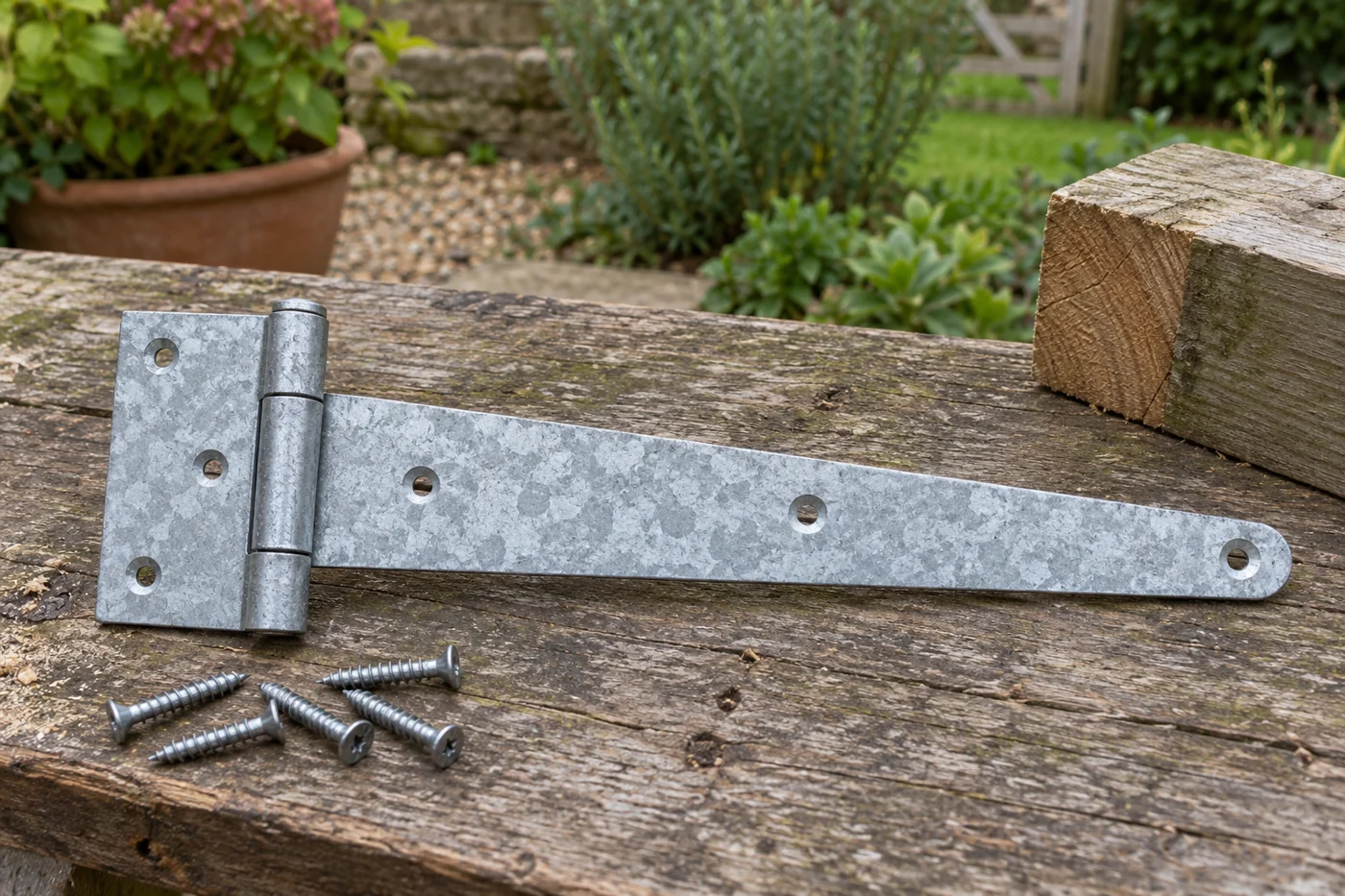
Compare the main garden gate hinge types
Choose by the job the hinge must do: consider a rated T hinge for straightforward rail mounting, an adjustable hook-and-band set when later alignment matters, or a purpose-made self-closing system when the gate must return closed. Then check the exact set against the gate’s finished width, weight, frame and required mounting gap.
| Hinge type | Useful starting point | What to check |
|---|---|---|
| T hinge | A lighter framed pedestrian gate with a suitable horizontal rail | Published capacity, strap fixing positions and enough sound timber behind every required fixing |
| Hook-and-band hinge | A timber gate where a long band can connect to substantial framing | Hook mounting, offset, lift-off restraint and the exact set’s permitted gate size |
| Adjustable hook-and-band hinge | A gate where future alignment adjustment is valuable | Adjustment range, access to the nuts and clearance throughout the swing |
| Butt hinge | A gate specifically detailed with suitable stiles and a compatible mounting face | Exterior suitability, permitted loading, timber thickness and any required recess |
| Self-closing gate hinge | A pedestrian gate that should return to its closed position | Closing capacity, leaf size, post shape, mounting gap and compatible latch |
“Heavy duty” is not a complete specification. Two hinges with similar black finishes can have different bearings, fastener requirements and load limits. Start with a product whose manufacturer supplies fitting instructions and a clear intended use.
T hinges versus adjustable hook-and-band hinges
A T hinge has a short mounting leaf for the post and an extended strap for the gate. It is straightforward to position when the strap lines up with a substantial rail. Its simplicity is useful, but a basic fixed hinge offers little scope to recover alignment without moving the fixings.
An adjustable hook-and-band set provides a means of shifting the gate relative to the post within the hardware’s permitted range. That can make later latch alignment easier. For example, Jacksons’ adjustable hinge set is intended to allow realignment as timber moves. Adjustment is a maintenance feature; it cannot make an unstable post or a distorted gate frame sound.
Choose the mechanism that fits the job, then compare individual products. A well-specified T hinge can be a better choice than an ungraded adjustable hinge with no usable installation information.
Check gate width as well as weight
A gate’s weight acts some distance from the hinge line. Making a gate wider increases that distance, so a weight rating cannot be separated from the manufacturer’s permitted dimensions and mounting conditions.
As a simple comparison, imagine two uniformly built leaves of equal weight: one is 36 in (91.4 cm) wide and the other 48 in (121.9 cm). Their centres of mass are approximately 18 in (45.7 cm) and 24 in (61 cm) from the hinge side. The wider leaf creates about one-third more static turning effect at the support. This explains why width matters; it is not a method for assigning a hinge capacity.
Count the finished assembly, including cladding, mesh, frame, brace, latch and any added trim. A replacement gate with close-boarded infill can be much more demanding than the open frame it replaces. Solid infill also changes wind exposure, which a simple vertical weight figure does not describe.
Read the rating as a complete installation
Check whether the published limit applies to one hinge, a pair or a specified system. Then look for the maximum leaf width, hinge spacing, gate material, minimum post size, mounting gap and required fasteners. Do not multiply a single figure by the number of hinges unless the manufacturer explicitly permits that calculation.
D&D’s TruClose Heavy Duty wood-gate specifications, for example, list a self-closing weight limit alongside an approximate gate size, minimum post size and ideal gate gap. These are connected requirements for that product, not dimensions to apply to every garden gate.
If a listing gives only a hinge length and “heavy duty,” ask for the missing information before buying. Choosing a larger-looking hinge is not a dependable substitute.
Plans for your next build
Compare the designs and check the fit for your project
Make sure the hardware fits the frame and opening
Decide on the hinge before finalising the gate width. Hinges differ in their pivot position and in how much space they need between the leaf and post. A completed gate that fills almost the whole opening may leave no room for the hardware you intended to use.
Strap length needs to match a real rail
The familiar advice to use a strap equal to a fraction of the gate width is only a rough shopping shortcut. What matters is the exact product specification and whether its required fixing positions land in adequate framing. A long strap screwed mainly into thin face boards does not provide the same connection as one correctly attached to a structural rail.
Lay the hinge template over the frame drawing. Check the rail face, timber thickness, corner joint and screw positions together. A fixing that falls through a gap, into a damaged edge or too close to a joint needs a design change, not simply a longer screw.
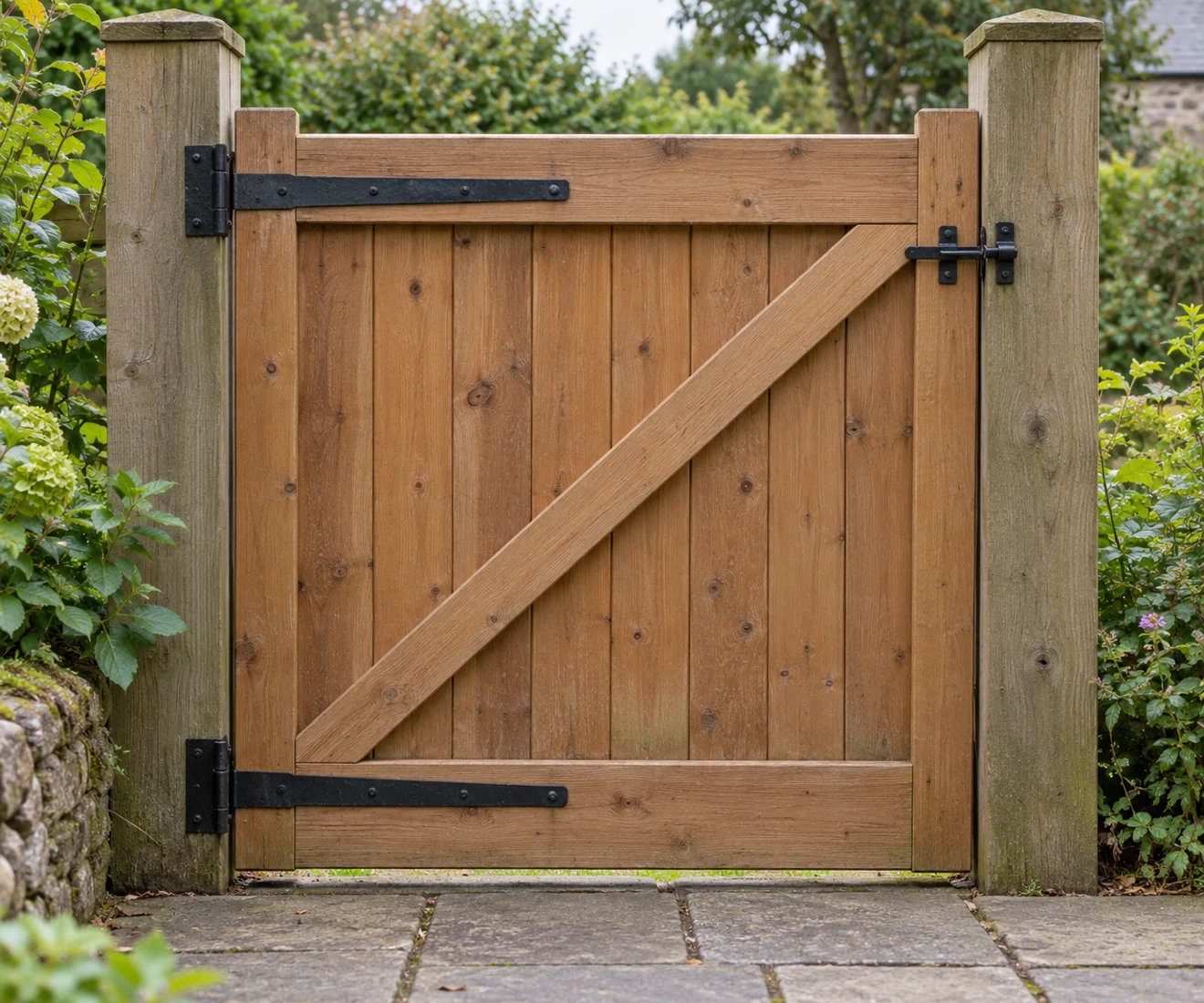
Our wooden gate construction guide explains frame squareness and brace direction. If you are choosing a complete design first, browse The Garden Gate Collection and coordinate its frame with the selected hardware.
Test the whole swing
Check the gate against the post, latch, nearby wall and ground through the intended opening angle. Clearance when closed does not prove that the back edge will clear the post when opening. Cranked straps, offset pivots and projecting post caps can all change the result.
On rising ground, an ordinary hinge does not lift the leaf as it opens. Resolve the swing direction or ground arrangement before hanging. A special rising hinge has its own geometry and loading requirements; it should not be treated as a universal cure for a slope.
Keep the hinge axes aligned
The hinge pivots need to share the intended axis. A third hinge mounted out of line can make a gate bind. Follow the hinge maker’s spacing and alignment instructions rather than placing extra hinges wherever a rail happens to be.
Check handing, opening direction and any lift-off feature before assembly. Some hook-and-band arrangements can allow the leaf to be lifted from the hooks; use the manufacturer’s retention arrangement where required. Do not improvise by reversing components against their instructions.
Choose corrosion protection and fixings together
Black is a colour, not a corrosion specification. Check what the hinge is made from, what coating protects it and whether it is suitable for the timber treatment and exposure. The screws or bolts need compatible protection too.
Salt exposure, persistent damp and preservative-treated timber can change the specification. Swedish Wood’s fastener guidance distinguishes corrosion protection by application and identifies stainless-steel requirements for certain exterior timber uses. Use the hardware and timber suppliers’ requirements for your own assembly.
A hinge supplied without fixings leaves several decisions unresolved: diameter, length, head shape, number of fixings, pilot holes and possible through-bolting. Follow its schedule. Ordinary drywall screws are not a substitute. Our outdoor wood screw guide explains the wider selection process.
When self-closing hinges are worth choosing
Self-closing hinges are useful where a gate is repeatedly left open, but the entire gate must close and latch reliably. A spring cannot compensate for a dragging leaf, misaligned latch or obstruction. Test the assembled system from the positions specified in its instructions, then recheck after adjustment.
For a pool or other regulated safety barrier, the hinge is only one part of the required system. Choose the gate, latch, openings and closing arrangement against the applicable local requirements. A “self-closing” label alone does not establish compliance.
Will new hinges stop an existing gate sagging?
Only when the hinges or their connections are actually responsible. First check whether the post leans, the frame has moved out of square, the fixings have loosened or the hinge has worn. Pulling a distorted frame back into position with adjustable hinges can leave the underlying fault unresolved.
Use the sagging gate diagnosis guide before ordering replacements. It helps separate a frame repair from a post repair or hardware change.
Take this checklist to the supplier
- Finished gate width, height, thickness and weight
- Post material, size and mounting-face dimensions
- Frame drawing showing rails, joints and available fixing positions
- Opening direction, required angle and ground clearance
- Need for adjustment, self-closing or lift-off restraint
- Timber treatment and environmental exposure
- The complete hinge set’s rating, instructions and fixing schedule
Once the hardware is chosen, settle the clearances before cutting the frame. That sequence avoids a gate that looks right on the bench but has no room to operate on its posts.
Match the hinge to a complete gate design
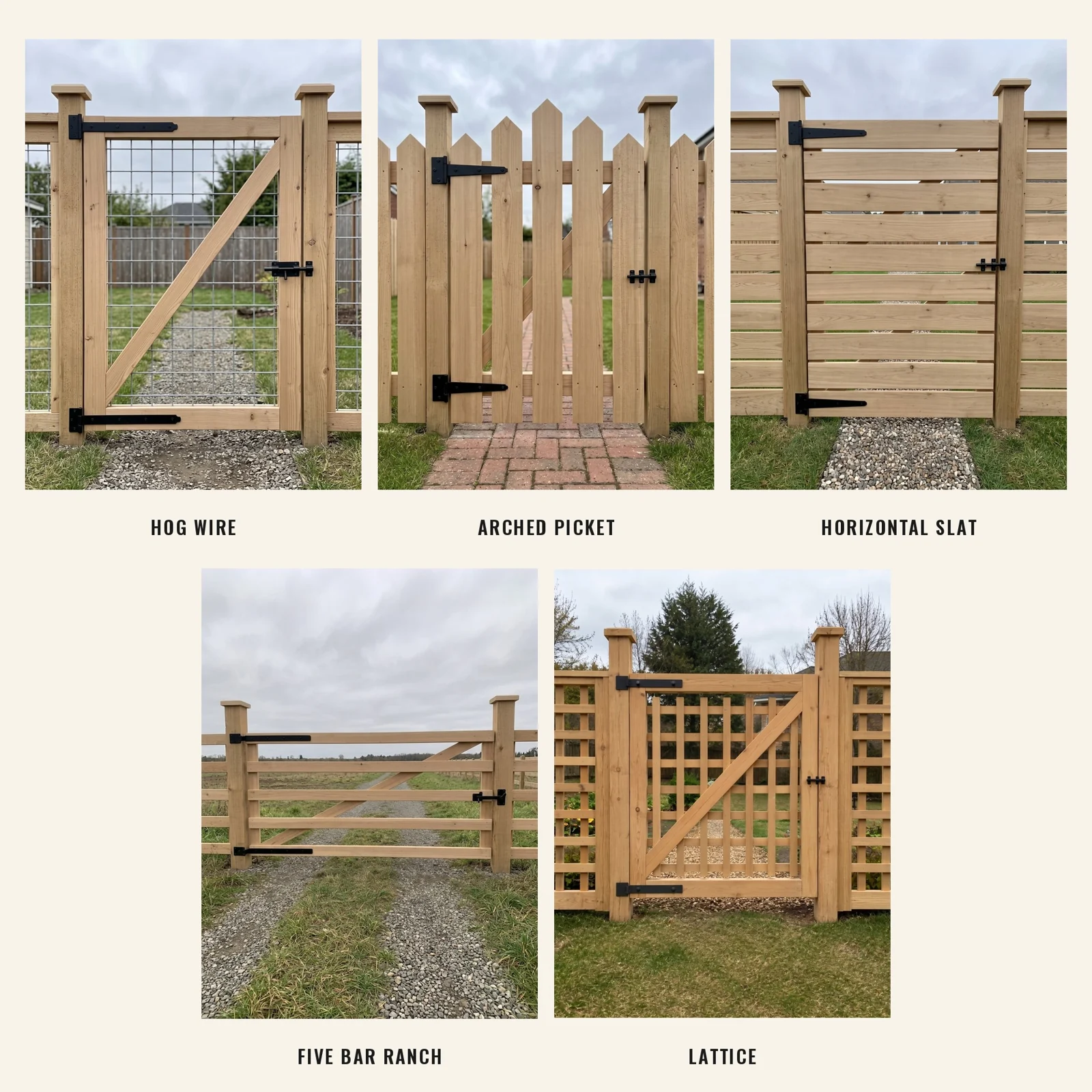
If you are building a new gate, start with the design and coordinate its rail positions, opening clearances and brace with the chosen hinge instructions. Explore the five designs in The Garden Gate Collection and check the listing for the included plan details.
View the Garden Gate Collection →
Repairing a gate you already own? Follow the sagging gate diagnosis before buying replacement hinges.
Common questions
Do I need two hinges or three?
Use the number and spacing specified for the chosen hinge system and gate. Adding a third hinge does not automatically increase the rated capacity or repair sagging, and all pivots must align.
Can I use indoor door hinges outdoors?
Only if that exact hinge is approved for the exposure, loading and mounting arrangement. Indoor hinges may lack suitable corrosion protection or a useful rating for the wider, wind-exposed leaf of a garden gate.
Should I buy the hinges before building the gate?
Choose the hinge model before fixing the gate’s final dimensions. Its required gap, mounting surfaces and fixing positions affect the frame and opening.