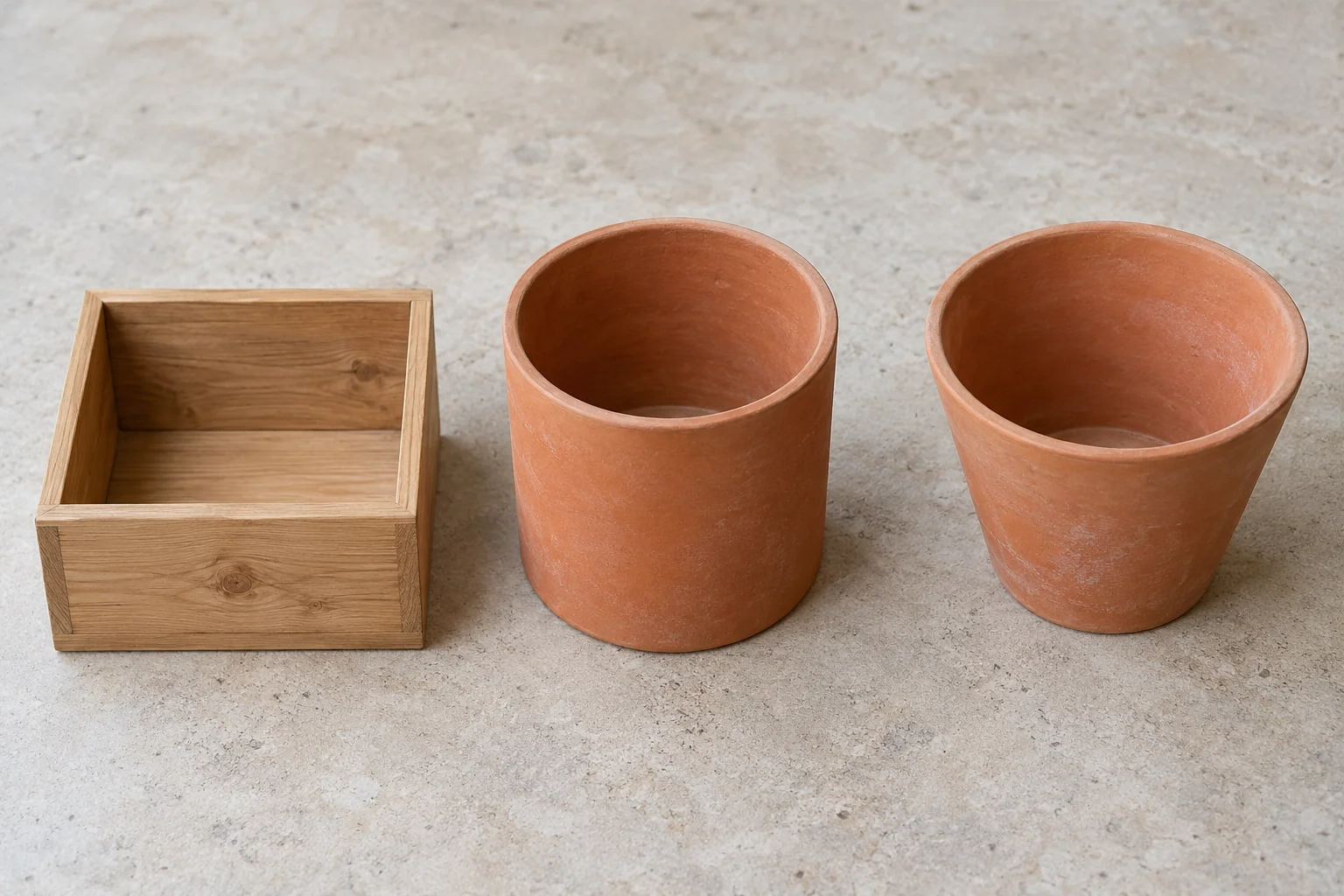
Calculate the growing space inside your planter, subtract what is already there and turn the remaining volume into whole bags
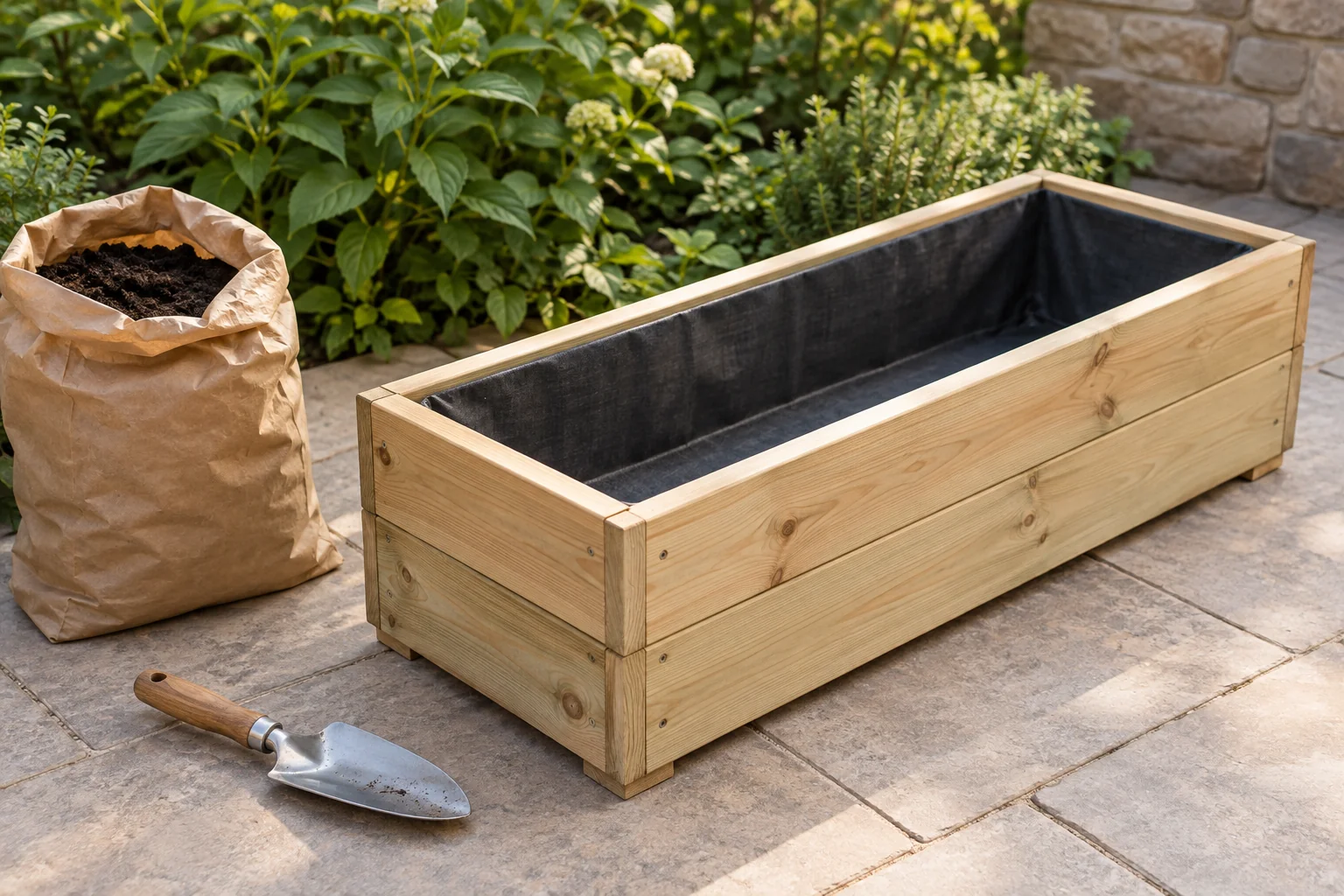
Illustrative imageMeasure the usable inside space before buying growing medium
How much compost do I need for a planter?
For a rectangular planter, multiply internal length × internal width × fill depth in centimetres and divide by 1,000 to get litres
Subtract rootballs or retained mix once, multiply by the number of identical containers, then divide by bag volume and round up
Here, compost means the potting compost or potting mix used to grow plants in containers; garden compost is a soil improver and is not automatically a complete container mix
Planter compost calculator
Measure to the level you intend to fill, below the rim
Your compost estimate
Fresh growing medium
Whole bags to buy
Capacity per container
Estimated mix left over
Bag counts use unrounded volumes · Loose fill, settling and rootball estimates can change the amount you use
Measure where the compost will actually go
Use the usable inside space, including the height of any raised internal base · Schematic, not a construction drawing
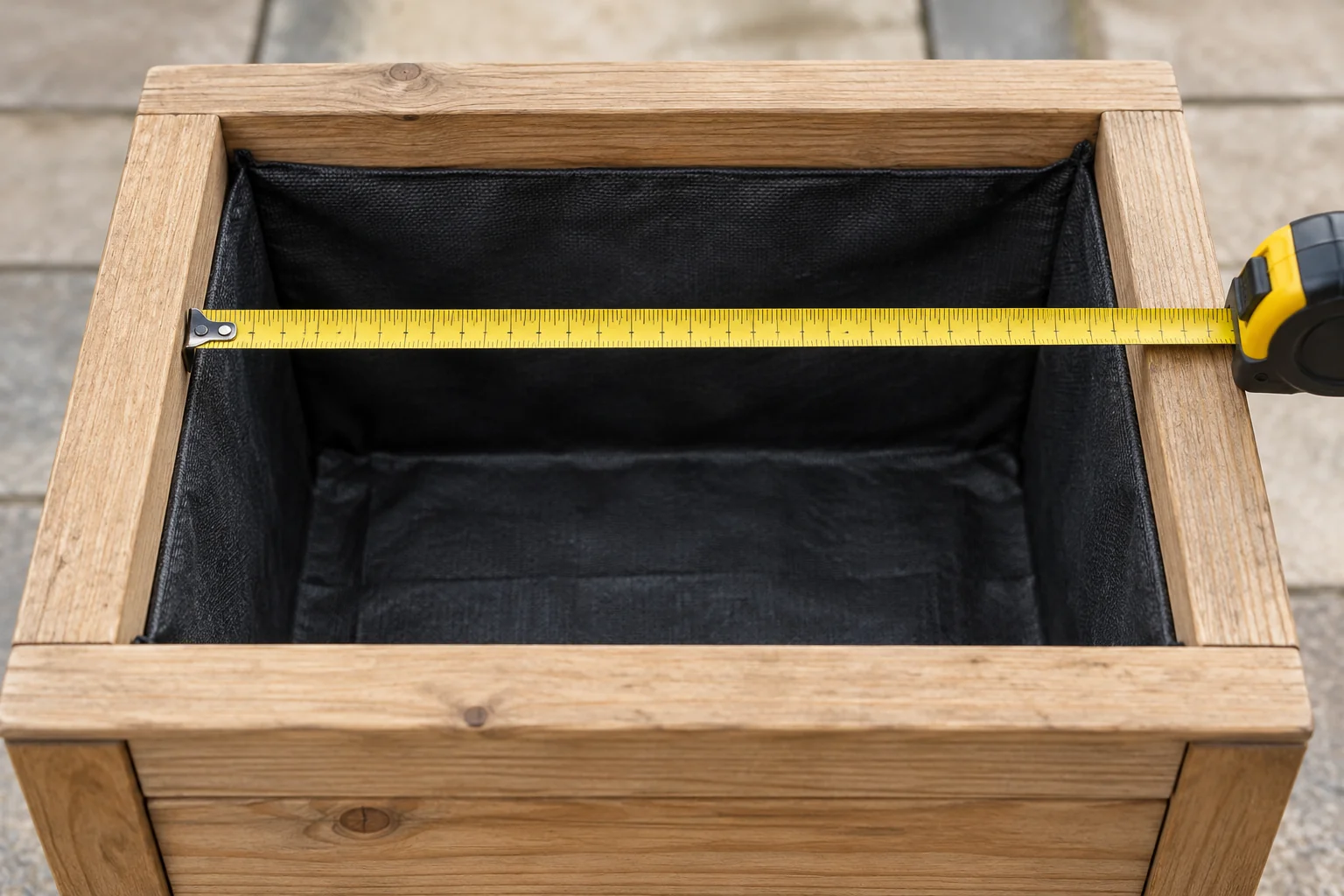
Measure between the inside walls
Measure the growing space, excluding the timber thickness, cap boards and decorative overhangs
If the interior contains substantial dividers or a raised floor, measure each usable compartment or the space above that floor
Illustrative imageTake the measurement between the inside faces, excluding walls, caps and overhangs
Choose the finished fill line
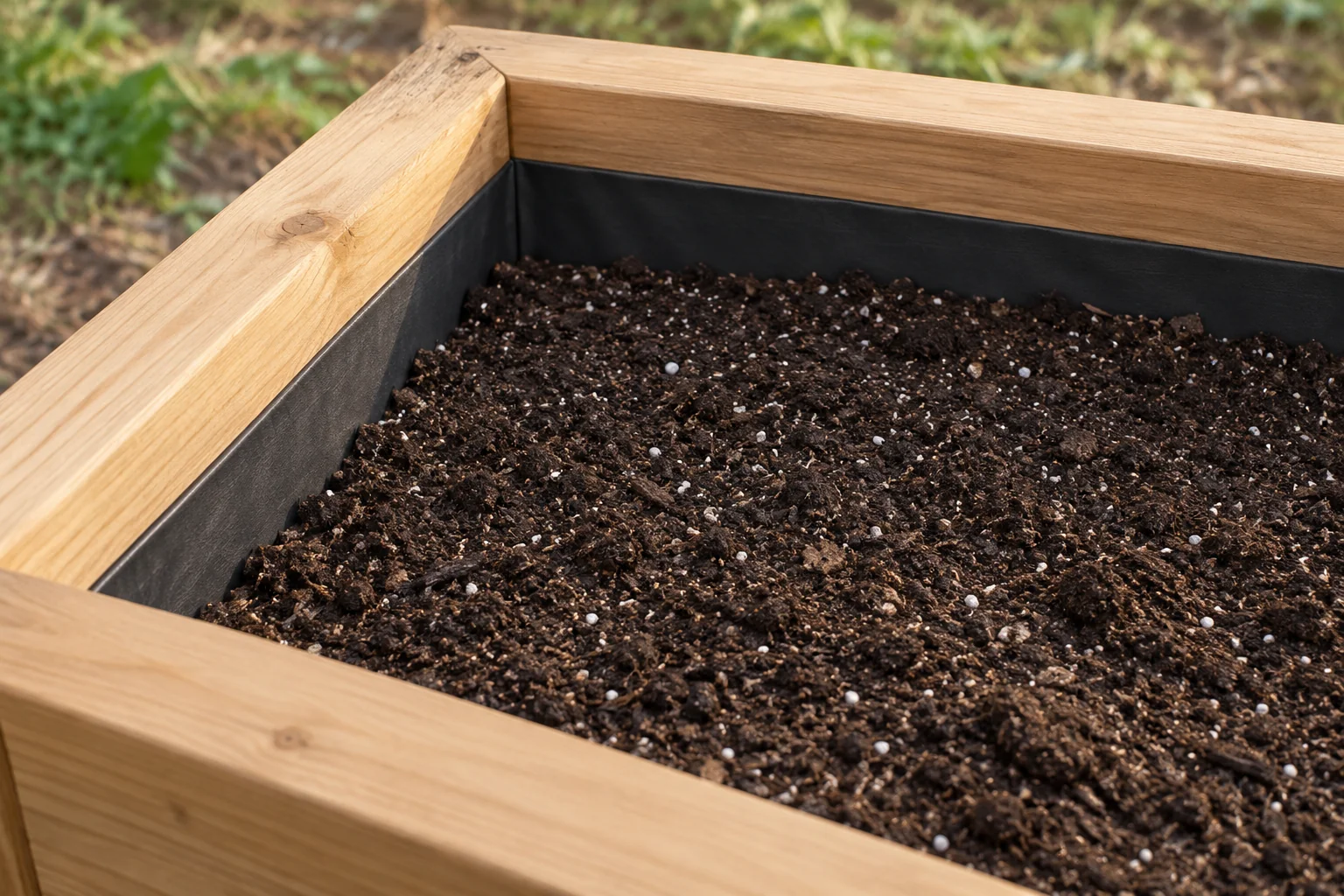
Measure vertically from the inside base to the intended compost surface, leaving room for watering below the rim
The RHS container guide shows positioning rootballs within the container and leaving a gap above the compost so watering does not wash it over the edge
If a separate surface dressing will occupy part of the depth, decide where the growing mix itself will finish before entering the measurement
Illustrative imageUse the intended soil level for fill depth and leave watering space below the rim
Account for the shape
Use rectangular for a box with straight sides, straight round for a cylinder, and tapered round for a pot narrowing towards its base
For the tapered option, take the upper diameter at the intended fill line, which can be smaller than the opening at the rim
For example, a 100 × 40 cm outer box with walls 2 cm thick would have an internal length of 96 cm and width of 36 cm if that simple wall construction were the only deduction
At 30 cm fill depth, the outside measurements imply 120 L, while those inside measurements give 103.68 L, a difference of 16.32 L before allowing for plants
Real corner posts, liners, battens and floors can change the usable space further, so this example explains the effect rather than supplying dimensions for a particular planter
Rootballs and existing mix
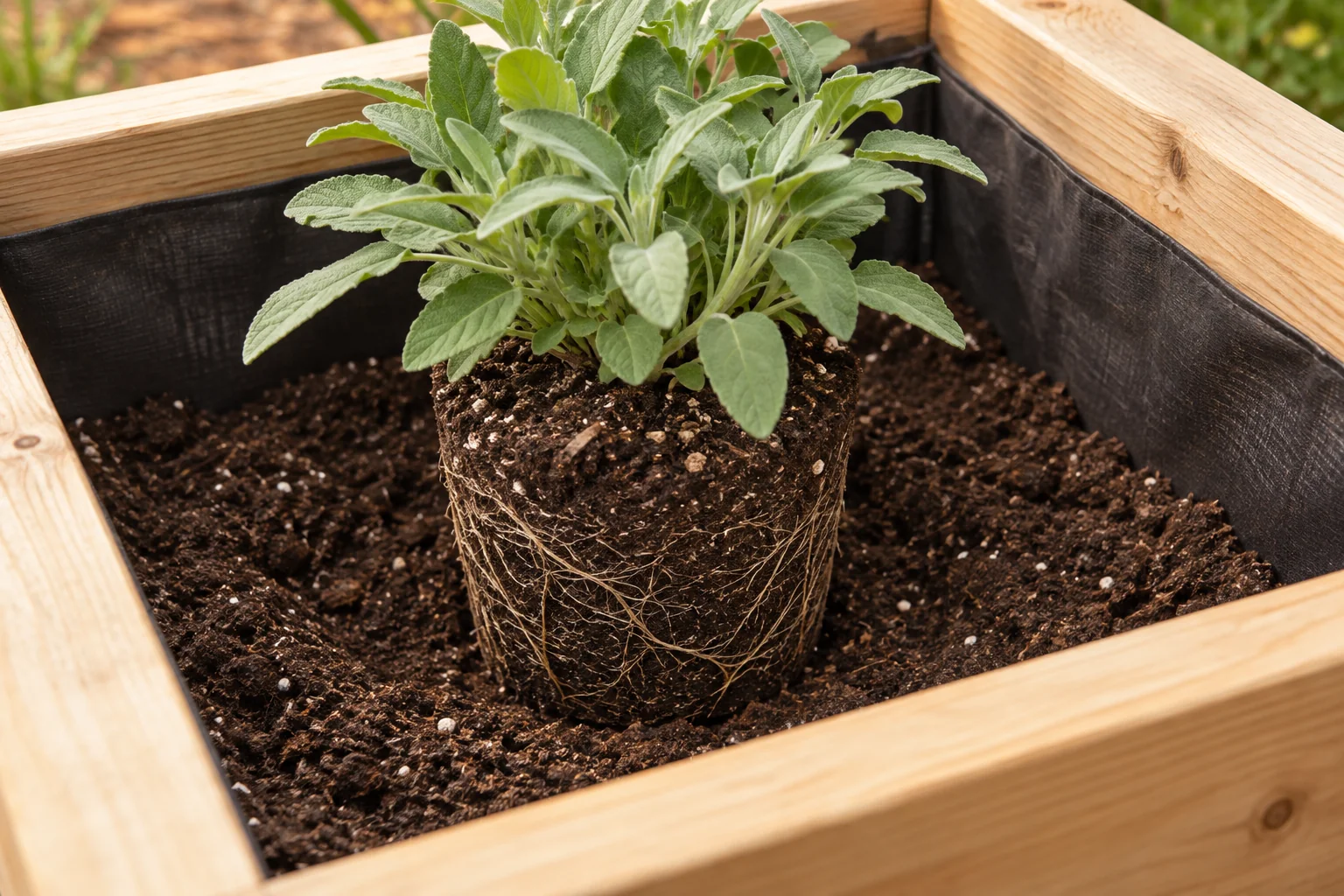
Illustrative imageThe rootball occupies part of the planter’s usable volume
The empty-container capacity includes space that a rootball or retained growing medium may already occupy; only the remaining space needs fresh mix
Enter occupied volume per container, then let the calculator multiply it by the quantity of identical containers
How to estimate a rootball
Use a known nursery-pot capacity as a rough starting point if the rootball fills it, allowing for taper, watering space and missing soil
Alternatively, a cylindrical estimate 20 cm across and 18 cm deep is about 5.65 L; an irregular or tapered rootball may occupy less
If the likely range is 4–6 L, calculate both ends of that range; if the bag count stays the same, a more precise estimate may not change the purchase
Subtract retained mix only once
Either measure the full growing space and subtract occupied volume, or measure only the unfilled space; do not deduct the same rootball or retained mix twice
For a raised internal floor, measure fill depth above it and exclude the void underneath
Formulas for three common shapes
Illustrative image
RectangularStraight roundTapered round
Choose the formula that matches the usable inside shape; tapered pots need both diameters
Shape
Measurements in centimetres
Volume in litres
Rectangular
Internal length L, width W and fill depth h
L × W × h ÷ 1,000
Straight round
Internal diameter d and fill depth h
π × d² × h ÷ 4,000
Tapered round
Diameter D at fill line, internal base diameter d and fill depth h
π × h × (D² + Dd + d²) ÷ 12,000
The tapered formula describes a truncated cone with straight sides between circular sections; it is an approximation for curved, bulging or irregular containers
Use a stated usable capacity where available for an unusual shape, or divide a complex box into simpler non-overlapping compartments and add their volumes
One litre is 1,000 cm³ and one cubic foot is approximately 28.3168 L; if you calculate a rectangular volume in inches, divide by 1,728 to obtain cubic feet
If your building plan uses millimetres, divide each dimension by 10 before entering centimetres; entering millimetres as centimetres multiplies the resulting volume by 1,000
Quick capacity reference
These calculated examples use internal dimensions and the intended fill depth, with no rootballs, retained mix or extra allowance deducted
Shape
Internal dimensions and fill depth
Capacity
40 L bags
Rectangular
60 × 30 × 25 cm
45.0 L
2
Rectangular
80 × 40 × 30 cm
96.0 L
3
Rectangular
100 × 40 × 40 cm
160.0 L
4
Rectangular
120 × 40 × 40 cm
192.0 L
5
Straight round
30 cm diameter × 25 cm depth
17.7 L
1
Straight round
40 cm diameter × 30 cm depth
37.7 L
1
Tapered round
40 / 30 cm diameters × 30 cm depth
29.1 L
1
Tapered round
50 / 35 cm diameters × 40 cm depth
57.3 L
2
Volumes are displayed to one decimal place; bag counts use the underlying unrounded values and assume 40 L bags
These are reference sizes, not capacity claims for Firesided products or retail planters with matching outside dimensions
Worked example: buying bags for one planter
Rectangular planter with a rootball
Use 90 cm internal length, 30 cm internal width and 25 cm fill depth, with an estimated 7.5 L already occupied
90 × 30 × 25 ÷ 1,000 = 67.5 L capacity 67.5 − 7.5 = 60 L fresh mix 60 ÷ 40 = 1.5, rounded up to 2 bags of 40 L 80 − 60 = 20 L estimated surplus
The subtraction belongs before the bag calculation; rounding the empty capacity into bags first hides how much fresh mix you actually need
Straight round pot
For a 40 cm internal diameter and 30 cm fill depth, the capacity is approximately 37.70 L
π × 40² × 30 ÷ 4,000 = 37.70 L capacity 37.70 − 4 L rootball estimate = 33.70 L fresh mix Buy 1 bag of 40 L, leaving about 6.30 L
Measure the diameter across the pot through its centre; the distance from the centre to the wall is the radius and must not be entered as the diameter
Tapered round pot
For a 40 cm diameter at the fill line, 30 cm internal base diameter and 30 cm fill depth, the straight-sided tapered volume is approximately 29.06 L
π × 30 × (40² + 40 × 30 + 30²) ÷ 12,000 = 29.06 L capacity 29.06 − 3 L occupied = 26.06 L fresh mix With 20 L bags, buy 2 bags, leaving about 13.94 L
Treating this pot as a 40 cm-wide cylinder would overestimate its capacity by about 8.64 L because the lower section is narrower
Imperial example
An empty rectangular growing space 24 × 12 × 10 inches holds 2,880 in³, or approximately 1.67 ft³ / 47.19 L
With bags labelled 1 ft³, buy two; select cubic feet as the bag unit in the calculator, even if you measured the container in centimetres
Combine different containers before rounding into bags
The quantity field is for identical containers with the same dimensions and occupied volume; calculate different sizes separately
For example, three empty rectangular boxes requiring 45 L each, the round pot needing 33.70 L and the tapered pot needing 26.06 L together require about 194.76 L
3 × 45 + 33.70 + 26.06 ≈ 194.76 L fresh mix 194.76 ÷ 40 ≈ 4.87, rounded up to 5 bags of 40 L
Rounding each container separately would suggest eight 40 L bags; combining the volumes allows the remainder from one bag to be used in another container
Only combine orders this way when the containers need the same growing medium; plants requiring different mixes should have separate totals
Avoid the common calculation mistakes
Mistake
Why the result changes
Correction
Using outside dimensions
Includes walls and other solid construction
Measure the usable inside space
Using the rim height as fill depth
Includes watering space or room for a dressing
Measure to the intended mix surface
Using the upper diameter alone for a tapered pot
Treats the narrower bottom as a full-width cylinder
Use both diameters at the relevant levels
Deducting occupied space twice
Understates the fresh mix needed
Choose one consistent measurement method
Rounding every pot into bags
Counts unused portions as if they could not be shared
Add compatible fresh-mix volumes first
Should I automatically add 10%?
The calculator adds no fixed allowance; examine uncertain dimensions, rootball estimates and settling instead, then decide whether extra stock is useful for your project
A displayed estimate of 39 L with a 40 L bag leaves little margin, while 60 L purchased as two 40 L bags already leaves 20 L; the same extra percentage is not equally useful in both cases
Will the bag volume exactly match the final fill?
Treat the label as the purchase quantity and the result as a planning estimate; handling, firming and settling can change the volume actually used
Can I use garden compost instead of potting mix?
The RHS distinguishes decomposed garden material used to improve soil from prepared growing media for containers; choose the mix for the plant and container, since a volume calculation is not a planting recipe
This calculator estimates volume and bag count; it does not calculate the loaded weight or assess the planter’s construction
Rectangular prism, cylinder and conical-frustum volume formulas, converted from cm³ to litres
Imperial conversions use 2.54 cm per inch and 1,728 in³ per ft³
Reference table and worked examples calculated by Firesided · Display rounding is separate from the calculator’s whole-bag rounding · Examples use hypothetical internal dimensions and estimated occupied volumes
Check drainage before filling
Before adding the calculated volume of compost, make sure excess water has a clear route out. See our guide to planter drainage holes for hole placement, liners and keeping outlets clear.